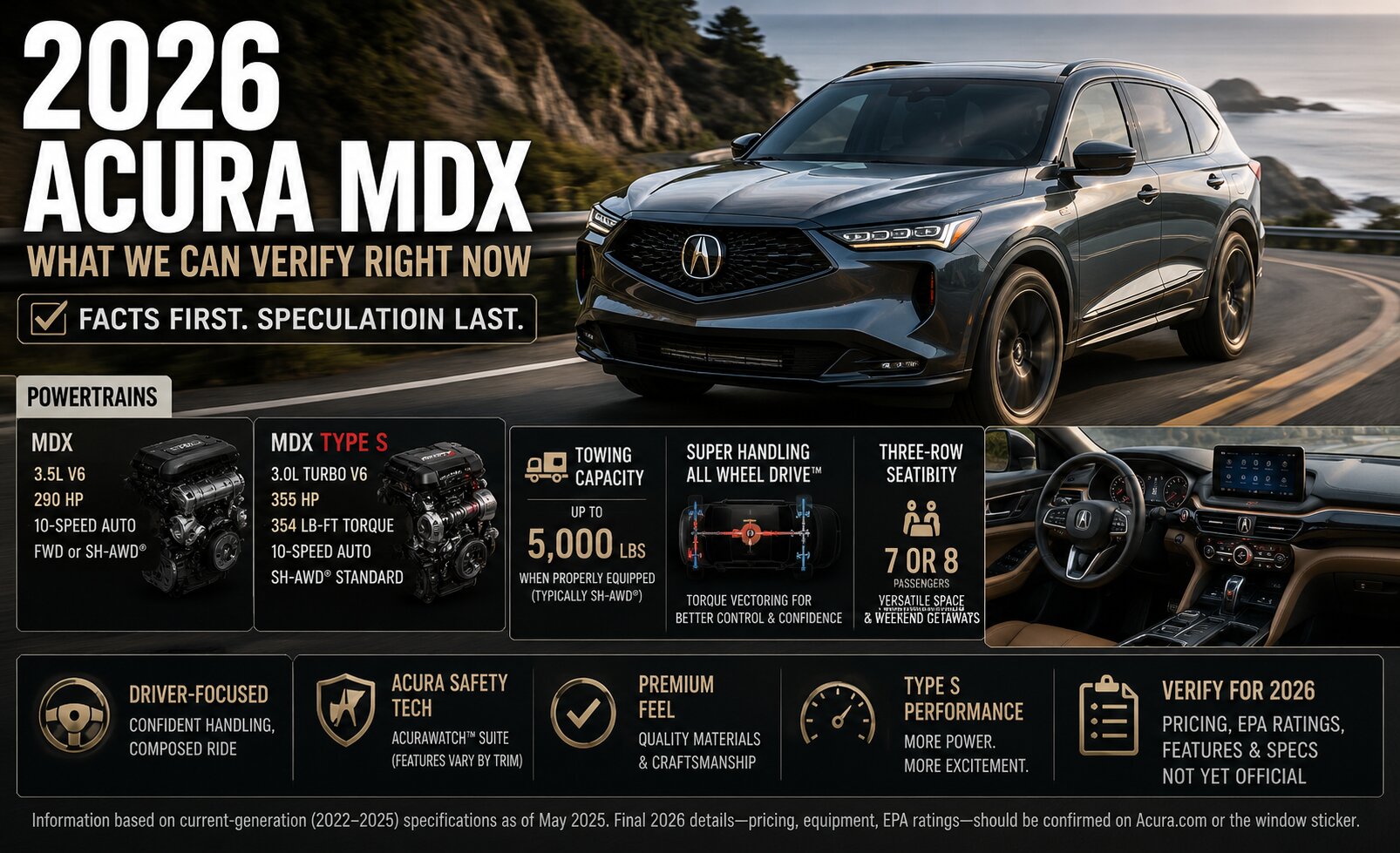
What we can verify about the 2026 MDX right now
Acura’s MDX is one of the longest running three row luxury crossovers in the U.S., and the current generation arrived for the 2022 model year. It is built on a dedicated platform (not a rebadged Honda Pilot), offers Acura’s torque vectoring Super Handling All Wheel Drive (SH AWD) system, and is sold in familiar trims that typically include MDX, Technology, A Spec, Advance, and the performance oriented Type S. Those are stable, widely reported pillars of the lineup.
Where things get tricky is anything that depends on final 2026 ordering guides. As of this writing, Acura has not published a complete, universally verifiable 2026 U.S. spec sheet in the way it does once pricing and equipment are fully released. Some outlets will speculate about feature reshuffles and packaging year to year; this review avoids that. The fundamentals below are based on well established specifications for the current generation MDX and the most consistently documented configurations in recent model years. If Acura changes powertrain output, standard equipment, or EPA ratings for 2026, those updates should be confirmed against Acura’s official site or the final Monroney label.
Where the MDX sits in the market
The MDX competes in a crowded, high expectation segment: three row crossovers with premium badges and family duty baked in. The most direct rivals include the Audi Q7, BMW X5 (third row optional on some versions), Volvo XC90, Lexus TX (newer and very family first), Infiniti QX60, Genesis GV80 (third row available), and to a degree the Mercedes Benz GLE with third row option. There is also the elephant in many driveways: well equipped mainstream three rows like the Honda Pilot, Kia Telluride, Hyundai Palisade, and Toyota Grand Highlander that can undercut luxury brands on price while offering comparable space.
MDX has always tried to split the difference. It aims to feel more athletic than the softest family haulers while staying easier to live with than some high tech European alternatives. That mission is reflected in its control layout, chassis tuning priorities, and Acura’s continuing emphasis on SH AWD as a handling tool rather than a simple traction aid.
Powertrains and key specs (based on available specifications)
For most buyers, the heart of the MDX is its naturally aspirated 3.5 liter V6 paired with a 10 speed automatic transmission. In current generation form it is widely listed at 290 horsepower. Acura pairs it with front wheel drive or SH AWD depending on trim and configuration. This setup matters because it sets the MDX apart from several turbocharged competitors that chase low end torque and headline numbers.
The step up is the MDX Type S, which uses a turbocharged 3.0 liter V6 paired with a 10 speed automatic and SH AWD as standard equipment. Output is commonly published at 355 horsepower and 354 lb ft of torque for recent model years of this generation. It is not an all out track SUV, but it changes the personality of the vehicle more than any wheel package or appearance trim ever could.
Towing capacity is one of those practical stats families actually use when shopping. The current generation MDX is commonly rated up to 5,000 pounds when properly equipped (typically with SH AWD). Front wheel drive versions are generally rated lower in many competitive sets. Because tow ratings can vary by configuration and year, shoppers should confirm their exact vehicle’s rating on the window sticker or owner documentation.
Fuel economy depends heavily on drivetrain and trim. EPA numbers have varied slightly by model year and equipment; historically the V6 MDX lands around the high teens to low twenties combined depending on FWD versus AWD, while Type S tends to be lower due to power and standard AWD. For a 2026 purchase decision, final EPA estimates should be verified once posted for that model year.
Design: conservative lines with purposeful proportions
The current MDX shape looks more traditional than some rivals that lean into coupe rooflines or exaggerated surfacing. That ends up being a virtue for many American buyers because it preserves headroom and keeps sightlines relatively honest from behind the wheel. The long hood and upright cabin proportions still read Acura rather than anonymous crossover.
A Spec trims typically add darker exterior accents and larger wheels for visual punch without changing core hardware. The Type S adds functional intent through its available performance focused equipment (such as air suspension on some versions in recent years) but still stays within Acura’s restrained design language.
If you want your luxury three row to shout, an Audi Q7 with certain packages or a BMW X5 M Sport will do it more readily. The MDX instead tries to look expensive by being cleanly drawn and well assembled rather than flashy.
Cabin layout: premium where it counts, not obsessed with reinvention
The MDX cabin is one of its strongest arguments because it feels designed by people who still drive with muscle memory rather than by committee chasing screen time metrics. You get real buttons for key functions in most versions of this generation: climate control you can adjust without hunting through menus, a clear instrument display strategy depending on trim, and a center console that does not require relearning every time you switch cars with your spouse.
Acura’s infotainment approach has been controversial because many MDX models use a touchpad style controller instead of direct touchscreen interaction (touchscreen availability depends on model year and trim). Some drivers adapt quickly; others never stop wishing they could just reach out and tap icons like they do in a Lexus TX or many Hyundai Kia products. The saving grace is that once you learn where common functions live, day to day operation can be predictable. Predictability is underrated when you are juggling kids, navigation prompts, and highway merges.
Material quality is generally convincing for the price class: soft touch surfaces where elbows land, sturdy switchgear feel, and seats that tend to prioritize long distance comfort over aggressive bolstering (Type S aside). It may not have quite the same jewelry like detailing you get in an Audi Q7 or Volvo XC90 at their best trims, but it also avoids some of the fussy minimalism that can make routine tasks feel like software demos.
Seating comfort and driving position
The MDX gets the basics right: a natural driving position with good outward visibility for a modern crossover, plus seat height that makes entry easy without feeling like you are perched on a stool. For many drivers coming out of older SUVs or minivans, that matters more than any ambient lighting theme.
Front seat comfort tends to be one of Acura’s quiet strengths over long drives. Depending on trim and options you may see features like ventilation or upgraded leather; those details must be verified for a specific 2026 build because packaging can change year to year.
The second row usually offers either a bench or captain’s chairs depending on configuration (again dependent on trim). Captain’s chairs make third row access simpler but reduce maximum seating count; families should decide early whether they prioritize seven passengers with easier walk through access or eight passenger capacity with a bench.
Third row reality check: usable for real people, not magical
No midsize luxury three row escapes physics. The MDX does better than two row crossovers with optional jump seats because it was engineered as a three row from day one. Still, adults will find third row comfort depends on how far forward second row passengers are willing to slide.
In typical family use, the third row works best for kids and shorter adults on shorter trips. That places it in familiar company: Audi Q7 remains one of the better packaged options among European rivals; BMW X5’s optional third row can feel tighter; Volvo XC90 is workable but not generous; Lexus TX tends to lean more spacious overall depending on configuration because its mission skews family first.
The practical question is access: if your household regularly uses all three rows several times per week, you will notice how smoothly seats fold and how intuitively latches work more than you will notice stitching patterns. Acura generally does well here with straightforward mechanisms, but shoppers should test this themselves at the dealer because small ergonomic differences become daily friction points fast.
Cargo flexibility: strong fundamentals for family duty
The MDX’s boxier profile pays dividends behind the second row compared with more tapered rivals. With all seats up you get space for grocery runs and strollers that fold compactly; with the third row down it becomes genuinely useful for weekend trips; with both rear rows folded you have enough length for bulky home improvement runs without resorting to roof boxes immediately.
Exact cargo volume numbers vary by measurement method and model year reporting standards; Acura publishes them officially for each model year. Because this review avoids unverified figures for 2026 specifically, treat cargo impressions here as functional guidance rather than an exact cubic foot claim.
On the road: why it still feels built around the driver
The MDX has long leaned into steering feel and chassis balance more than some rivals that prioritize isolation above all else. In this generation that shows up as confident turn in for a vehicle of its size and weight, plus body control that stays composed during quick lane changes or cloverleaf ramps. You do not buy an MDX because you expect sports car reflexes from a three row; you buy it because it rarely feels sloppy.
SH AWD remains central to that impression when equipped. Rather than simply sending torque rearward when slip occurs, Acura’s system has historically been able to apportion torque side to side at the rear axle to help rotate the vehicle through corners under power. In plain terms: it can make an SUV feel like it wants to follow your steering inputs instead of washing wide when pushed.
The base V6 does its job with smoothness rather than drama. Naturally aspirated power means response builds progressively rather than arriving as an early turbo surge. Some buyers prefer turbo torque for effortless low speed shove; others appreciate how linear throttle response makes parking lot maneuvers and wet weather modulation easier.
If you want genuine extra punch without stepping into full performance SUV pricing territory, Type S is where Acura makes its case most clearly. The turbocharged V6 brings stronger midrange thrust for passing and grades while keeping refinement intact when cruising.
Ride comfort versus handling: trim choices matter
The MDX’s ride quality depends heavily on wheel size and suspension specification. Larger wheels common on A Spec style trims can look great but may transmit sharper impacts over broken pavement compared with smaller wheel setups. That tradeoff shows up in every brand right now; it just hurts more when your daily route includes frost heaves or expansion joints.
If your priority is relaxed highway comfort over visual stance, pay attention to tire sidewall height when choosing trims. If you are drawn to Type S specifically for its added hardware (and potentially air suspension depending on configuration), confirm exactly what equipment your chosen vehicle includes because features can be package dependent by model year.
Noise isolation: close to luxury expectations without going numb
A premium three row needs to manage wind noise around mirrors and pillars plus tire roar from wide all season rubber. In general terms this generation MDX is competitive here: quiet enough for conversation at highway speeds without forcing everything into an isolated bubble.
Some rivals do isolate better under certain conditions; Volvo XC90 has an especially calm vibe at cruise when configured well; Audi Q7 can feel notably hushed on smoother pavement; Lexus often majors in serenity even if steering feel takes a back seat. The Acura counters by keeping road feedback present but not tiring when properly equipped.
Brakes and confidence under load
Brake feel matters in family vehicles because smooth stops keep passengers comfortable while confident pedal response keeps drivers relaxed in traffic surprises. The MDX generally aims for linear pedal tuning rather than overly boosted bite at initial application.
If towing is part of your plan even occasionally, consider SH AWD configurations first due to typical higher tow ratings (verify per vehicle) plus better stability when pulling small campers or boats within rated limits. It will not replace a body on frame SUV for heavy towing duty; it does cover many real world recreational needs without forcing buyers into trucklike compromises every day.
Controls and tech: mostly sensible choices, one stubborn one
The best compliment you can give cabin controls is that you stop thinking about them after two days of ownership. On that front the MDX does well with physical controls where they matter most.
The lingering debate centers on infotainment interaction method in many versions of this generation: Acura’s touchpad interface asks drivers to learn its logic instead of using direct touch like most competitors now do across their lineups. Some drivers find it reduces fingerprints and encourages eyes up driving once learned; others find it adds friction when using Apple CarPlay or Android Auto style interfaces designed around touch inputs (availability standard versus optional varies by trim). This is worth testing yourself during an extended sit in dealership lot conditions because frustration here can color every commute more than any horsepower figure will.
Sophistication without overcomplication
The broader point in Acura’s favor is restraint. Many new luxury SUVs chase novelty through layered menus, capacitive sliders, or minimalist dashboards that bury simple tasks behind software decisions you did not ask for. The MDX largely avoids that trap by staying familiar where familiarity helps: clear buttons for climate settings plus traditional gear selection logic depending on model year design choices.
You may not get quite as much wow factor as sitting inside an EQE SUV or latest Mercedes cabin full of screens, but there is also less chance you will be annoyed by basic tasks six months later.
Safety systems: expected features but verify availability
Acura typically includes a suite of active safety technology under its AcuraWatch umbrella across its lineup (features often include adaptive cruise control capabilities, collision mitigation braking assistance functions, lane keeping support features). Exact feature names and standard versus optional availability can shift by model year and trim level; confirm on official specs for your intended 2026 configuration.
This review also avoids claiming specific crash test ratings for 2026 because those results depend on testing cycles from IIHS and NHTSA that may not yet reflect any running changes for that model year at publication time.
How it stacks up against key rivals
Audi Q7: The Q7 often feels more overtly luxurious inside with crisp materials and strong isolation at speed; it also offers solid third row packaging relative to some European peers. It can be pricier when similarly equipped and leans more toward polished calm than driver centric engagement compared with an SH AWD MDX configured similarly.
Volvo XC90: Elegant design inside and out plus comfortable road manners define Volvo’s approach. The XC90 emphasizes serenity over sportiness; some buyers love that immediately while others miss steering feedback compared with Acura’s tuning philosophy.
Lexus TX: Lexus built TX with family utility front of mind including space efficiency themes typical of Toyota group packaging strengths. If your top priority is third row friendliness plus easy tech interaction without learning curves, TX deserves cross shopping even if its driving character may not feel as eager as an MDX pushing through an off ramp.
Infiniti QX60: QX60 often wins shoppers who want straightforward comfort plus upscale styling at competitive pricing relative to German brands. Driving engagement tends to be less central than in Acura’s pitch; if steering feel matters to you during daily use, this difference shows up quickly during back to back drives.
BMW X5 (with optional third row): X5 can deliver sharper dynamics depending on configuration but packaging compromises come with trying to add occasional use third row seating into what remains fundamentally a two row oriented platform philosophy compared with purpose built three rows like MDX or TX.
Pros
Driver centered road manners: Especially with SH AWD equipped models, steering response and composure make everyday driving feel intentional rather than purely appliance like.
Sensible cabin controls: Physical controls where they matter reduce daily friction compared with trendier but fussier interfaces elsewhere in the segment.
Strong powertrain lineup: The standard V6 favors smoothness; Type S adds meaningful performance without turning into an attention seeking caricature.
Real three row packaging: Third row works for families who use it regularly for kids or occasional adults without feeling like an afterthought bolt on solution.
Cons
Infotainment learning curve: The touchpad based interface used in many versions can be polarizing versus touchscreen first systems common today; test before committing.
Third row still has limits: Like most midsize luxury three rows it remains best suited to kids or shorter adults unless second row passengers cooperate generously.
Trim tradeoffs affect comfort: Larger wheels common on sport appearance trims can reduce ride compliance on rough roads compared with smaller wheel setups.
The verdict: premium done the old fashioned way
The appeal of the 2026 Acura MDX should be familiar to anyone who misses luxury vehicles designed around driving first principles rather than constant digital novelty. Based on available specifications from this generation’s established lineup, it offers smooth V6 power (and genuinely stronger performance in Type S form), confident handling aided by SH AWD when equipped, plus cabin controls that remain closer to intuitive than experimental.
No part of this formula is perfect. Some shoppers will bounce off Acura’s infotainment interaction method immediately; others will decide they would rather have Lexus style ease or Audi level cabin sparkle even if it costs more or feels less engaging through corners. Still, if your priority list includes balanced road manners, straightforward usability, flexible cargo space without resorting to minivan vibes, and premium touches delivered without overcomplication, the MDX continues to make sense in America’s luxury three row conversation.
0 comments
Join the discussion around this article.
Please login to comment.