
BMW X5 vs Genesis GV80: two definitions of modern luxury
Set a BMW X5 beside a Genesis GV80 in a dealership row and the comparison feels obvious at first glance. Both are midsize luxury SUVs sized for American life, with three-row availability, strong towing numbers, and the kind of cabin presentation that is meant to justify a premium badge. Spend more time with each, though, and their priorities separate. The X5 is still built around BMW’s long-standing promise that a family vehicle can respond like a sport sedan when the road tightens. The GV80 is tuned to soothe, to insulate, and to flatter its occupants with design and features that read expensive without shouting.
This piece focuses on U.S.-market vehicles and widely published specifications. Where figures vary by model year, drivetrain, wheel size, or options, the differences are called out rather than glossed over. If you are shopping used or cross-shopping multiple years, treat any single number as trim-specific and confirm it against the window sticker or manufacturer spec sheet.
Model lineup and powertrains: familiar formulas executed differently
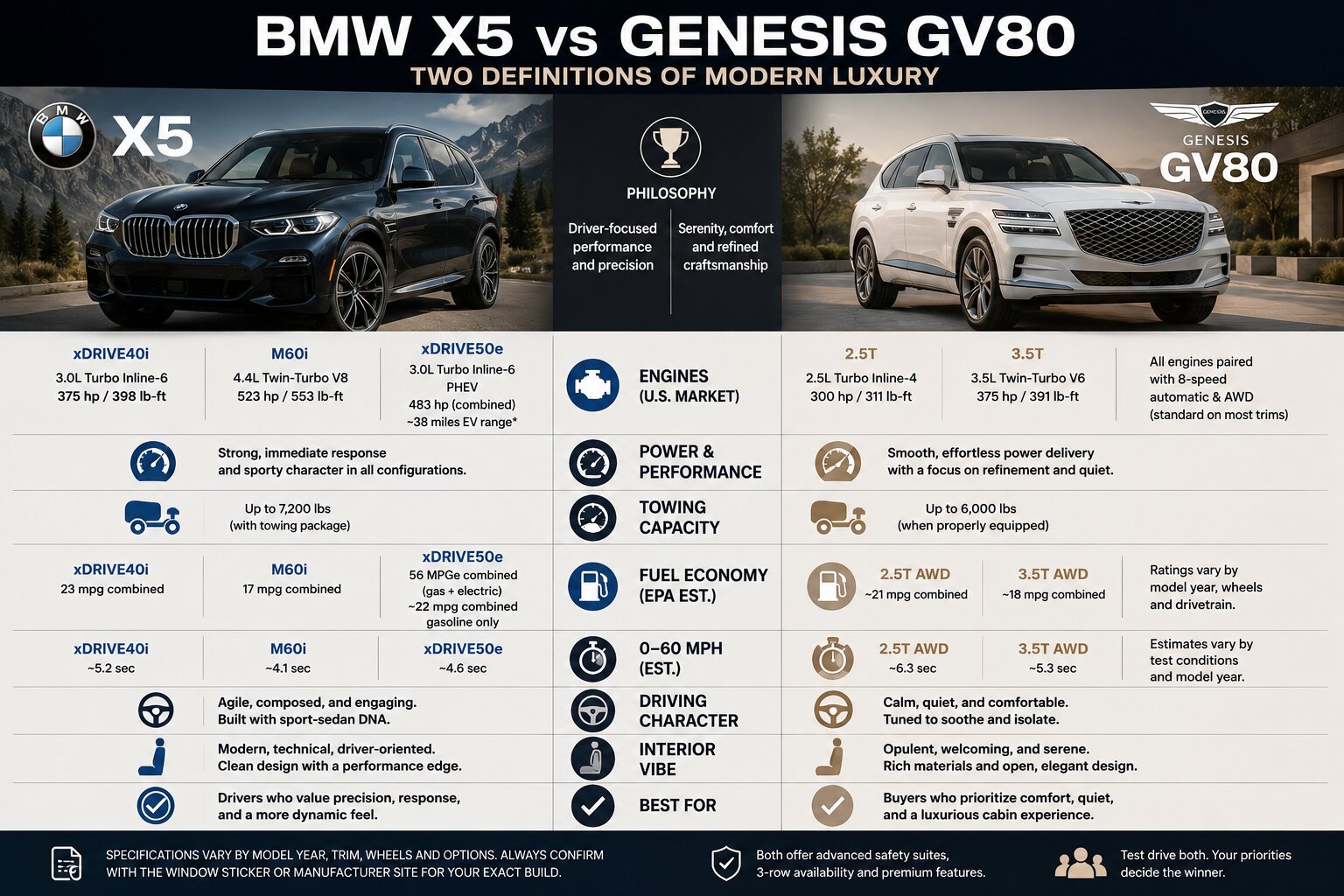
BMW X5 (current generation G05) is offered in the U.S. with three main personalities: the six-cylinder xDrive40i, the V8-powered M60i (formerly M50i), and the plug-in hybrid xDrive50e (which replaced the earlier xDrive45e). All use an 8-speed automatic transmission and all-wheel drive in typical U.S. configurations. The core engine is BMW’s turbocharged 3.0-liter inline-six (B58) with 48-volt mild-hybrid assistance on recent model years. Output for the xDrive40i is widely published at 375 horsepower in current U.S. specification (post-refresh). The M60i’s twin-turbo 4.4-liter V8 sits at 523 horsepower in current spec. The xDrive50e plug-in hybrid pairs a turbo inline-six with an electric motor for a combined 483 horsepower.
Genesis GV80 in the U.S. has typically been offered with a turbocharged 2.5-liter inline-four and a twin-turbocharged 3.5-liter V6, both paired with an 8-speed automatic and available all-wheel drive (AWD is standard on many trims). Widely cited outputs are 300 horsepower for the 2.5T and 375 horsepower for the 3.5T. Those numbers matter because they frame the entire character of the vehicle: even when power is similar on paper between an X5 xDrive40i and a GV80 3.5T, the BMW’s calibration tends to emphasize immediacy and drivetrain responsiveness, while Genesis leans into smoothness and quiet.
Competitors overlap heavily: Mercedes-Benz GLE, Audi Q7, Lexus RX (a size class down but often cross-shopped), Acura MDX (especially for three-row needs), Volvo XC90, and for buyers who want performance flavoring, Porsche Cayenne. In that field, the X5 positions itself as the driver’s choice among mainstream luxury brands; the GV80 positions itself as a comfort-forward alternative that borrows some cues from traditional flagship luxury without adopting their price structure.
Power delivery in daily use: similar numbers can feel very different
The easiest way to understand these two is to think about how they answer your right foot at 25 mph in traffic versus how they behave at 75 mph on a long interstate grade.
X5 xDrive40i (375 hp) has become something of a benchmark because BMW’s turbo inline-six is broad-shouldered across the rev range and typically paired with quick, decisive transmission programming. Even without quoting acceleration times that vary by year and test method, you can expect confident merging power and a sense that the drivetrain is always awake. Mild-hybrid assistance in newer versions also tends to smooth restarts and fill small gaps in torque delivery during low-speed transitions.
GV80 3.5T (375 hp), on paper, matches that headline horsepower figure exactly. In practice, Genesis tunes its twin-turbo V6 to feel refined first. The eight-speed automatic generally prioritizes unobtrusive shifts over snap responses. For many buyers this is precisely the point: you get strong passing power without constant reminders from the powertrain that it wants to play.
The GV80 2.5T (300 hp) changes the conversation if you regularly carry passengers or live at altitude. It is not underpowered in a vacuum, but in this weight class it asks more of itself when loaded up or climbing long grades. For shoppers who want effortless pace rather than adequate pace, the 3.5T tends to be the more satisfying match for the vehicle’s mission.
If your driving includes frequent short trips where silence matters more than throttle response, it is worth acknowledging what makes the X5 xDrive50e plug-in hybrid (483 hp) distinctive: electric operation for local errands when charged, plus substantial combined output when you lean on it. EPA-rated electric range varies by model year; for recent U.S.-spec xDrive50e it is widely published at around 38 miles. Real-world range depends heavily on temperature, speed, terrain, tires, and HVAC use.
Towing: capability is close enough to matter
Midsize luxury SUVs often tow boats, small campers, or car trailers not because owners tow every weekend but because they want confidence when they do.
The BMW X5 is widely rated at up to 7,200 pounds when properly equipped (towing package required). That figure applies broadly across key trims in recent years but should still be verified for your exact configuration.
The Genesis GV80, when properly equipped with its factory towing provisions and typically paired with AWD and the appropriate engine, is commonly rated at up to 6,000 pounds. Again, confirm by model year and drivetrain.
The difference between 6,000 and 7,200 pounds can be meaningful if you already own a trailer near that threshold or plan to upgrade later. For many owners towing well below either maximum rating, what matters more is stability and brake confidence on long descents. The X5’s chassis tuning often feels more buttoned-down under load; the GV80 leans toward calm steadiness rather than athletic tautness.
Fuel economy: efficiency depends heavily on which version you choose
This comparison can become misleading if it ignores how wide each lineup spreads.
The X5 xDrive40i carries EPA ratings that are commonly listed at roughly 23 mpg combined in recent U.S.-spec form (ratings vary by year and wheel choices). The X5 M60i V8 drops into lower territory; EPA combined figures are commonly published around 17 mpg combined, again depending on configuration.
The X5 xDrive50e plug-in hybrid adds another layer because it has both MPGe ratings and gasoline-only mpg once the battery is depleted; those numbers vary by model year and test cycle updates. If you can charge at home consistently, it can materially reduce fuel stops for local driving.
The Genesis GV80, depending on engine and AWD versus RWD where available by year, generally lands in the high teens to low twenties combined by EPA rating. Widely published figures include approximately 21 mpg combined for some 2.5T AWD configurations and approximately 18 mpg combined for many 3.5T AWD configurations; wheel size can move those numbers.
If fuel economy is central rather than secondary, it becomes less about brand preference and more about choosing the right powertrain within each brand’s lineup: an X5 six-cylinder versus a GV80 four-cylinder will look different on paper than an X5 plug-in hybrid versus a GV80 V6.
The way they steer: sport-sedan reflexes versus deliberate calm
The headline question in this matchup is not whether either vehicle can hustle; it is how they communicate while doing it.
The BMW X5’s steering philosophy, even as modern electric power steering has evolved away from older hydraulic textures, remains oriented around precision. Turn-in tends to feel crisp for an SUV of this size; body motions are kept in check; there is usually an underlying sense of discipline through sweepers that makes you comfortable increasing pace without thinking about it too much. With available adaptive suspension equipment (availability varies by trim) the X5 can widen its bandwidth from reasonably supple cruising to noticeably firmer control.
The Genesis GV80’s steering philosophy reads as measured rather than eager. It aims to be stable on-center with gentle responses rather than quick reactions that could feel busy on broken pavement. Many luxury buyers prefer exactly this tuning because it reduces fatigue over long distances and makes the SUV feel settled in everyday commuting.
If your reference point is a sport sedan or a performance crossover like a Porsche Cayenne or BMW’s own X3 M40i, the X5 will feel closer in spirit even before you reach an M-badged variant. If your reference point is traditional luxury isolation from brands like Lexus or certain Mercedes-Benz configurations tuned for comfort first, the GV80 will feel more aligned with that expectation.
Ride comfort and noise: where Genesis makes its case
A luxury SUV earns its keep on imperfect roads: expansion joints, patched asphalt, coarse concrete freeways.
The GV80’s reputation, supported by broad media impressions since launch, centers on quietness and ride polish. Genesis pays attention to sound insulation and cabin serenity as part of its brand pitch in America. In typical daily use this comes across as reduced wind rush at highway speeds and a general hush over rougher surfaces compared with many sportier rivals.
The X5, particularly in sport-oriented trims or with larger wheels, can transmit more of what the road is doing into your hands and seat base. That does not automatically mean harshness; it means feedback and control are prioritized alongside comfort rather than behind it. On some configurations this balance feels ideal; on others it can feel slightly busy over sharp impacts compared with softer-tuned competitors.
Tire choice matters here more than many shoppers expect in this segment. Larger wheel packages tend to sharpen response but reduce sidewall compliance; both brands offer wheel upgrades that can change ride character substantially depending on trim.
Cabin design: German restraint versus Korean confidence
This is where personal taste becomes decisive.
The BMW X5 interior, especially after its recent refreshes with BMW’s curved display layout in many trims (a single glass panel housing digital instrument cluster plus central infotainment), feels contemporary and technical. Materials quality is strong where your hands land most often: steering wheel leather quality depends on trim; switchgear generally feels precise; seats offer wide adjustability depending on options such as multi-contour seating packages where available. The aesthetic leans modern European rather than ornate.
The Genesis GV80 interior has been praised for looking expensive quickly: sweeping forms across dash and door panels; upscale color palettes; quilted leather patterns depending on trim; open-pore wood themes on higher specifications; metal accents used generously enough to signal intent without turning into glare. Genesis also tends to offer features at price points where German competitors might reserve them for option packages or higher trims (feature-by-feature availability still varies by model year).
If you want your cabin to feel like an understated cockpit built around function first, BMW fits naturally. If you want your cabin to feel like a lounge designed to impress passengers immediately, Genesis often lands that first impression more directly.
User interface: iDrive sophistication versus simpler familiarity
User interface decisions shape daily satisfaction far more than brochure language suggests.
BMW iDrive, especially in its newer iterations tied to wide curved displays (commonly associated with iDrive 8/8.5 depending on model year), offers deep functionality but also asks more from its user when adjusting settings buried behind menus. BMW has historically balanced touchscreen interaction with physical controls such as iDrive rotary controller functionality; however control layouts have evolved over time toward more screen dependence in many models.
Genesis infotainment, centered around a wide dashboard display controlled by touch plus a rotary controller in many configurations, tends to emphasize clear graphics and easier acclimation for drivers moving up from mainstream brands. Depending on model year it may not feel as feature-dense as BMW’s ecosystem but can be less cognitively demanding day-to-day.
A practical note for shoppers who care about muscle memory: spend time adjusting climate settings during your test drive rather than just pairing your phone once and moving on. Climate controls are among the most frequently used functions; any system that makes them slower will show up as mild frustration six months later.
Seating comfort: supportive athleticism versus plush ease
X5 seating, particularly with upgraded seat options where available, tends toward firm support with good lateral holding relative to many comfort-first SUVs. This suits drivers who value posture over pillow-soft cushioning during long stints behind the wheel.
GV80 seating, especially in upper trims with premium leather packages available by year, often emphasizes initial softness while still providing adequate support for typical highway drives. It reads as welcoming immediately when you drop into it wearing business attire after a long day.
Both offer heating and ventilation features depending on trim level; massage functions appear on certain configurations but availability varies by model year and package selection so verify before assuming either vehicle includes them.
Cargo space and family practicality: both do the job differently
Midsize luxury SUVs live double lives as family haulers and personal sanctuaries.
Cargo volume figures vary significantly by measurement method, seat position (two-row versus three-row), spare tire packaging choices where applicable, and model year updates; buyers should consult manufacturer specifications for their exact build. Broadly speaking, both vehicles provide competitive cargo space behind the second row for strollers or airport luggage runs without drama.
The third row question: both have offered three-row versions depending on year and configuration (X5 offers an optional third row in certain builds; GV80 offers an available third row). In this class those third rows are best viewed as occasional-use seating rather than adult-friendly accommodations for long trips; legroom tends to be limited compared with larger three-row SUVs such as BMW X7 or Hyundai Palisade sized alternatives outside this segment’s luxury positioning.
If you routinely carry adults in all three rows or need maximum cargo behind three rows up all the time, neither of these will feel like a full-size solution; you would be shopping one class up regardless of badge preference.
Driver assistance tech: competent suites with different personalities
Beneath marketing names like “Driving Assistance Professional” or “Highway Driving Assist,” most systems aim at similar outcomes: adaptive cruise control that maintains distance smoothly plus lane-centering help under certain conditions.
BMW’s systems, when equipped with its higher-level driver assistance packages available by trim/year, are generally regarded as sophisticated in lane keeping behavior while remaining clearly driver-supervised rather than hands-off autonomy in any universal sense.
Genesis driver assistance systems, including Highway Driving Assist functionality depending on model year/trim availability, have built a strong reputation for smoothness at highway speeds relative to price positioning within luxury segments broadly defined.
The responsible advice remains consistent regardless of brand: treat these systems as assistance rather than replacement for attentive driving; capability varies by road markings, weather conditions, sensor cleanliness, construction zones, and software calibration changes across model years.
A note on craftsmanship expectations: what feels premium after two years?
This question sits beneath every luxury purchase even if no one says it out loud during a test drive.
The BMW approach: premium often means tight assembly tolerances paired with engineering depth under the skin (powertrain sophistication; chassis tuning nuance; broad option catalog). The interior design tends not to chase flamboyance because BMW expects repeat buyers who value continuity across generations of vehicles.
The Genesis approach: premium often means rich visual presentation plus generous feature content relative to established European rivals. Genesis has worked hard to establish credibility quickly through design consistency across models and high perceived quality materials where eyes go first.
If you equate luxury primarily with mechanical polish at speed plus brand heritage tied to performance sedans of past decades, BMW still speaks fluently there. If you equate luxury primarily with serenity plus tactile richness plus feeling “fully loaded” without climbing through complex option ladders (which vary by market reality), Genesis has real appeal.
Tires, wheels, brakes: small decisions that change big impressions
A midsize luxury SUV can transform based on wheel diameter alone.
An X5 configured with larger wheels and sport packages will tend toward sharper transient responses but may deliver more impact harshness over potholes compared with smaller-wheel setups using taller tire sidewalls. Brake pedal feel also varies subtly between standard brakes and performance-oriented setups offered on certain trims such as M Sport packages or M60i hardware differences depending on year configuration details.
A GV80 configured with larger wheels, similarly common on higher trims due to styling expectations in this segment, can lose some of its natural ride advantage if tire sidewalls become too short for your local pavement reality. Buyers drawn to Genesis specifically for calm should pay attention here because wheel upgrades can work against what makes the vehicle special.
The ownership experience without talking price: service culture matters
You asked to avoid resale or value talk here; that does not mean ownership considerations disappear. They simply shift toward service experience expectations and day-to-day usability realities tied to brand ecosystems.
BMW ownership cadence: service intervals are dictated by onboard monitoring systems plus scheduled maintenance requirements depending on model year policy structures from BMW of North America (coverage terms vary). Dealer networks are extensive in major metro areas; service departments are accustomed to handling high volumes of leased vehicles rotating through predictable cycles alongside enthusiast-owned cars kept longer term.
Genesis ownership cadence: Genesis has expanded rapidly but dealer footprint can still be uneven depending on region compared with legacy German brands that have had decades to build networks in every affluent suburb corridor. That matters if convenient service access influences your stress level more than anything else about owning a luxury vehicle long-term.
If you live near multiple dealers for one brand but only one distant option for another brand, convenience becomes part of “luxury” whether anyone wants it to be or not.
If driving character leads your decision: which one fits?
Select the BMW X5 if:
You want an SUV that still feels engineered around steering accuracy and chassis composure first; you value brisk responses from throttle mapping through transmission logic; you appreciate BMW’s deeply integrated performance identity even when you are simply commuting; you might also consider stepping up into M60i territory if effortless V8 thrust matters more than fuel economy tradeoffs (EPA ratings reflect that).
Select the Genesis GV80 if:
You prioritize quiet-luxury calm over athletic feedback; you want passengers to notice materials richness immediately; you prefer a relaxed steering demeanor that does not ask much of you after hours behind the wheel; you see luxury as reduced noise plus elevated design rather than constant reminders of dynamic capability waiting underfoot.
A grounded shopping reality check: trim selection does most of the work here
The temptation is to compare badges instead of builds. In practice these vehicles shift meaningfully based on engine choice alone before options even enter the picture:
- An X5 xDrive40i aligns most closely against a GV80 3.5T. Both sit near 375 horsepower based on widely published specs yet deliver different personalities through calibration choices.
- A GV80 2.5T, while compelling for buyers who do not need maximum effortlessness under load, may feel less aligned against an X5 six-cylinder if your baseline expectation includes confident passing power without planning ahead.
- An X5 xDrive50e plug-in hybrid, if charging fits your lifestyle reliably, introduces quiet electric running that neither gasoline-only GV80 currently matches in U.S.-market form based on widely known lineup information through recent model years referenced here (Genesis has electrified products elsewhere in its range but not an electrified GV80 sold broadly as PHEV/EV across all years).
- An X5 M60i V8 belongs closer conceptually to performance-leaning alternatives like Porsche Cayenne S territory than it does to comfort-first interpretations of midsize luxury crossovers; fuel economy reflects that shift via EPA ratings commonly around 17 mpg combined depending on configuration.
The verdict lives in temperament rather than numbers
The honest outcome of an X5 versus GV80 comparison is not that one dominates across categories but that each expresses luxury differently even when key specs overlap closely enough to confuse casual shoppers browsing online listings late at night.
The BMW X5 remains one of the clearest expressions of “sport-sedan reflexes” translated into SUV form: controlled body motions, precise responses, powertrains calibrated to feel alert even when driven gently. It rewards drivers who still care about what happens through their fingertips when they turn into an off-ramp too quickly out of habit from smaller cars they used to love.
The Genesis GV80 makes its argument through calm competence: quiet cruising manners paired with cabins designed to impress without requiring deep knowledge of option codes or chassis package lore just to get something genuinely luxurious day-to-day. It suits buyers who want their SUV to lower their pulse rather than raise their expectations every time they take an empty back road home from dinner.

0 comments
Join the discussion around this article.
Please login to comment.