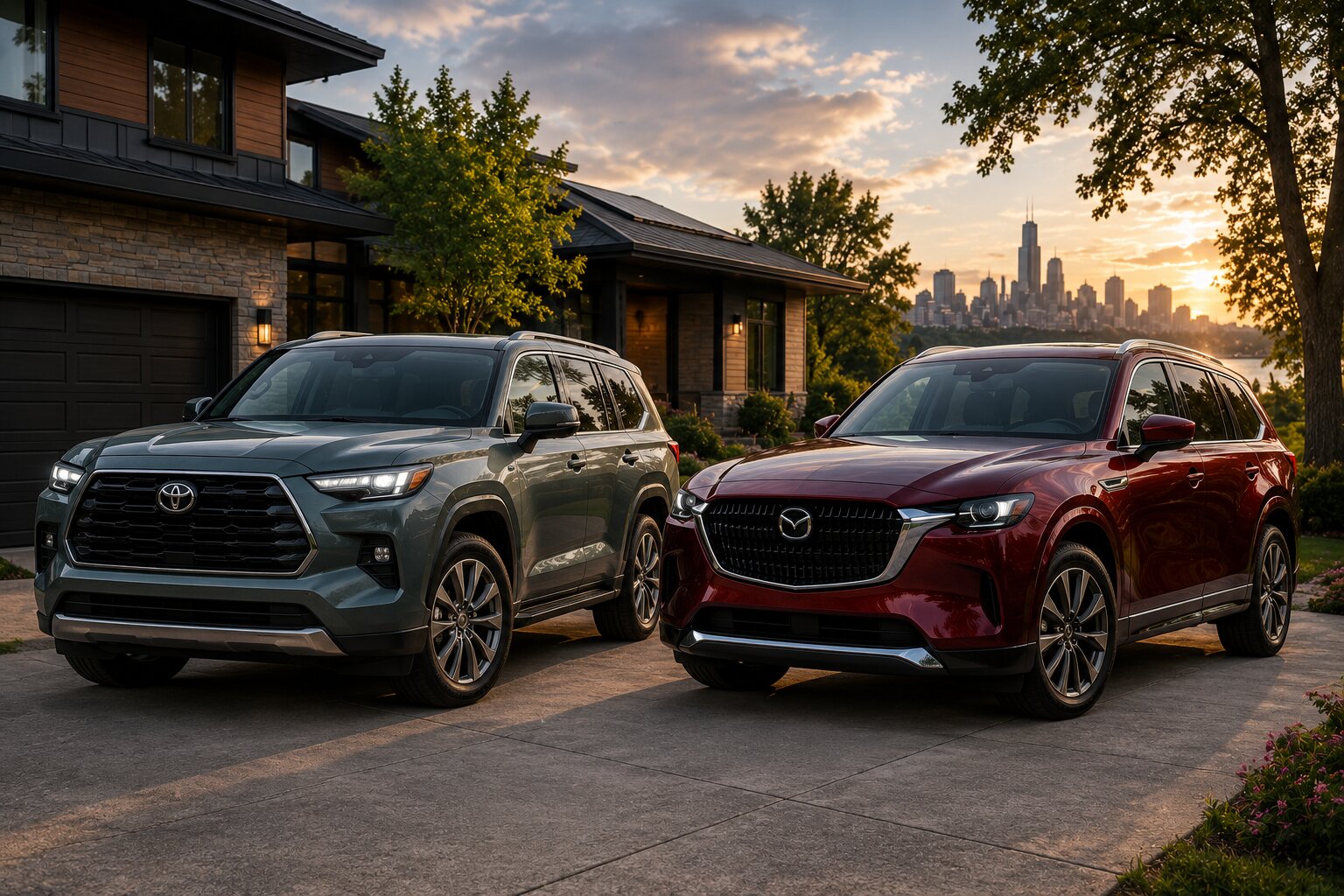
Toyota Grand Highlander vs Mazda CX-90: two three-row SUVs, two very different priorities
Put the Toyota Grand Highlander and Mazda CX-90 in the same driveway and the contrast is immediate. Both are three-row, family-sized SUVs aimed squarely at U.S. buyers who need real space and everyday civility. Yet their design briefs diverge. The Grand Highlander is an exercise in packaging: maximize usable room, simplify family logistics, keep the powertrains efficient, and make the cabin feel like a calm place to spend hours. The CX-90 leans into a more classic enthusiast pitch for a mainstream brand: rear-wheel-drive-based proportions, a new inline-six option, and a chassis tuned to feel deliberate rather than merely soft.
They also arrive at this moment with different kinds of pressure. Toyota’s three-row lineup has been popular enough that shoppers often cross-shop based on availability as much as preference, while Mazda is in the middle of a deliberate push upmarket, asking families to believe a Mazda can deliver near-premium road manners and interior ambiance without the premium-badge ownership costs. If your priority is family space above all else, you will likely gravitate one way. If you care about steering feel and body control even when the third row is occupied, you may lean the other.
Verified basics: model years, platforms, and direct competitors
Toyota Grand Highlander (U.S.) launched for the 2024 model year as a larger companion to the regular Highlander. It sits above the Highlander in overall size and interior room and offers three distinct powertrain themes: a turbocharged 2.4-liter gasoline engine (Toyota calls this “Turbo”), a hybrid system (“Hybrid”), and a higher-output hybrid (“Hybrid MAX”). It is not a body-on-frame SUV; it competes primarily with other unibody three-row crossovers.
Mazda CX-90 (U.S.) launched for the 2024 model year as Mazda’s new flagship three-row SUV. It rides on Mazda’s newer large-vehicle platform with rear-wheel-drive-based architecture (with standard or available all-wheel drive depending on trim). It offers a turbocharged 3.3-liter inline-six mild-hybrid setup in most trims and an available plug-in hybrid (PHEV) pairing a 2.5-liter four-cylinder with an electric motor.
Common cross-shops include the Honda Pilot, Kia Telluride, Hyundai Palisade, Subaru Ascent, Ford Explorer, Chevrolet Traverse (redesigned for 2024), Jeep Grand Cherokee L, Volkswagen Atlas, and in some conversations the Acura MDX and Lexus TX (which is closely related to the Grand Highlander). Those competitors matter because they frame what “good” looks like: third-row access that does not punish adults, cargo space that does not evaporate when all seats are up, calm highway ride quality, and powertrains that can tow without feeling strained.
Powertrains and output: Toyota’s menu vs Mazda’s inline-six character
The cleanest way to understand these two is through their powertrain philosophy.
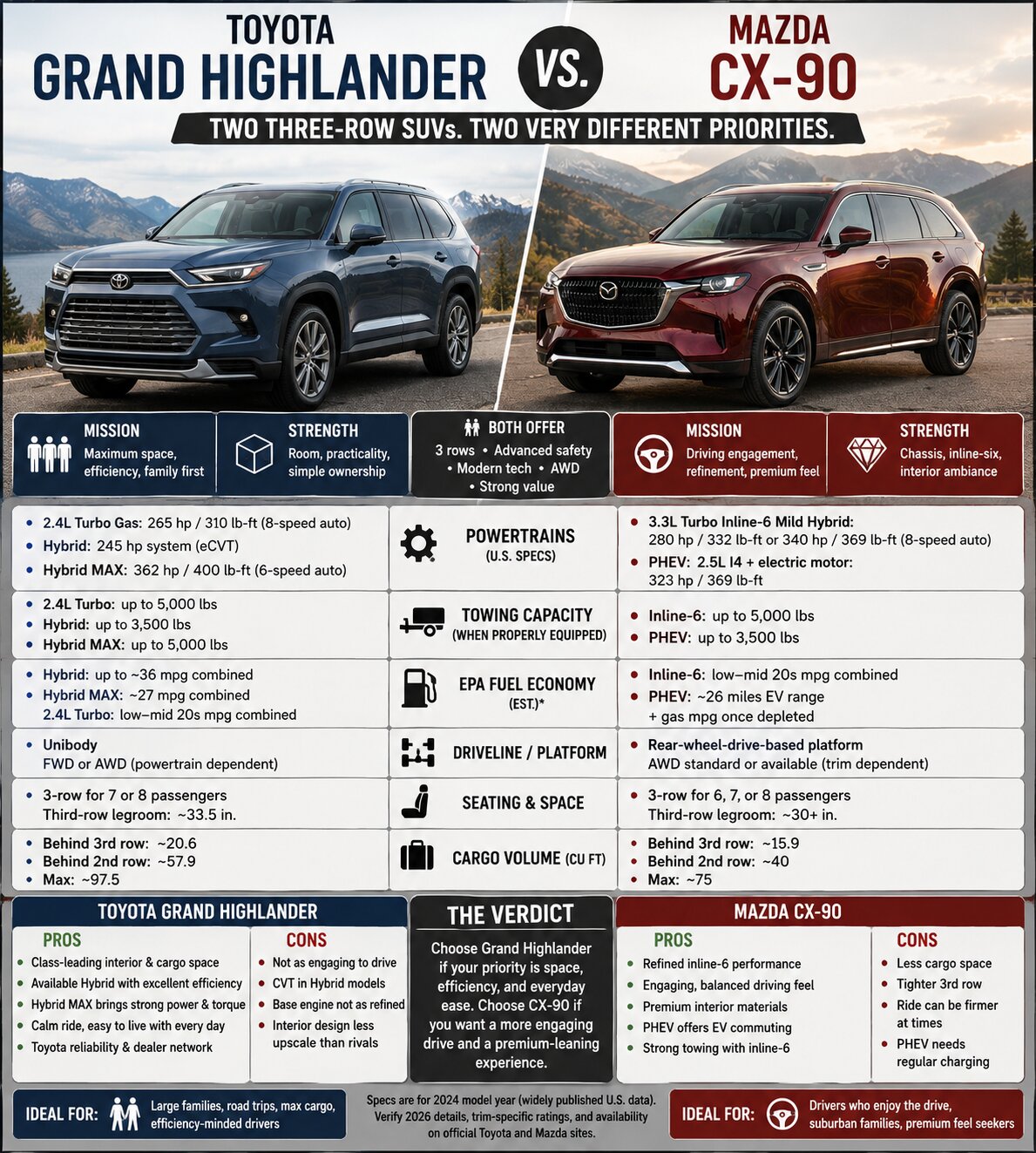
Grand Highlander offers three main choices in widely reported U.S. specifications:
• 2.4-liter turbo gas: 265 horsepower and 310 lb-ft of torque (8-speed automatic).
• Hybrid: 2.5-liter hybrid system rated at 245 combined horsepower (Toyota’s familiar eCVT-style setup).
• Hybrid MAX: a performance-oriented hybrid rated at 362 horsepower and 400 lb-ft of torque (6-speed automatic).
CX-90 keeps its lineup simpler but more personality-driven:
• 3.3-liter turbo inline-six mild hybrid: output varies by trim; widely published U.S. figures include 280 horsepower and 332 lb-ft in standard form, and up to 340 horsepower and 369 lb-ft in higher-output versions.
• Plug-in hybrid (PHEV): 2.5-liter four-cylinder plus electric motor for a combined 323 horsepower and 369 lb-ft.
On paper, Toyota’s Hybrid MAX has the biggest headline torque figure here at 400 lb-ft, which matters when you merge uphill with seven people aboard or pull away from a stop with a trailer behind you. Mazda counters with an inline-six that tends to deliver power in a smoother, more linear way than many turbo fours, even if its peak numbers depend on trim.
The practical takeaway is less about bragging rights than how you want your SUV to behave day to day. Toyota gives you clear lanes: prioritize efficiency (Hybrid), prioritize conventional simplicity with strong torque (2.4 turbo), or prioritize muscle with hybrid assistance (Hybrid MAX). Mazda’s inline-six route is about refinement and response without going full performance brand; it is also paired with an eight-speed automatic rather than a CVT-like unit in its mild-hybrid trims, which some drivers prefer for feel.
Towing: both are capable, but configuration matters
Towing capacity is one of those specs that looks straightforward until you realize it depends heavily on powertrain and equipment.
Toyota Grand Highlander towing (widely published U.S. ratings): up to 5,000 pounds with the 2.4 turbo and Hybrid MAX; the standard Hybrid is typically rated lower at 3,500 pounds. That split reflects what you would expect: hybrids tuned primarily for mpg usually give up tow rating compared with higher-output setups.
Mazda CX-90 towing (widely published U.S. ratings): up to 5,000 pounds for many inline-six trims when properly equipped; the PHEV is commonly listed at 3,500 pounds. Again, similar logic applies.
If towing is occasional but real (a small travel trailer, pair of jet skis, or a utility trailer loaded with home-improvement supplies), both can cover typical family needs in their higher-rated configurations. The decision becomes whether you want Toyota’s Hybrid MAX punch or Mazda’s inline-six torque delivery and rear-drive-based dynamics when you are loaded up.
Fuel economy: Toyota’s hybrids play the long game
This comparison can swing dramatically depending on which Grand Highlander powertrain you choose.
Toyota Grand Highlander EPA estimates (2024 model year), as widely reported for U.S.-spec vehicles:
• Grand Highlander Hybrid: up to about 36 mpg combined in certain configurations.
• Grand Highlander Hybrid MAX: commonly listed around 27 mpg combined. Exact figures vary by drivetrain and trim.
• Grand Highlander 2.4 turbo gas: commonly listed in the low-to-mid 20s combined depending on configuration.
Mazda CX-90 EPA estimates (2024 model year), widely reported:
• CX-90 inline-six mild hybrid: typically in the low-to-mid 20s combined depending on output level and drivetrain.
• CX-90 PHEV: EPA ratings include an electric-only range figure; widely published U.S. estimate is about 26 miles of EV range, plus gas-only mpg once the battery is depleted.
The honest interpretation: if your household racks up miles quietly but relentlessly (school runs plus highway commuting plus weekend sports), Toyota’s conventional Hybrid has a straightforward advantage because it does not ask you to plug in or change habits. The Mazda PHEV can be very compelling if your daily loop fits within its EV range and you actually charge regularly; without that charging discipline it becomes more like carrying around extra complexity for less payoff.
On-road personality: calm competence vs measured engagement
This is where these two separate into distinct emotional categories even before you start talking about trims.
Mazda CX-90’s driver-first tuning is part of its core identity. A rear-wheel-drive-based platform typically brings steering geometry and weight distribution advantages that can translate into more natural turn-in and better composure when you add speed or load. The CX-90 also tends to be described as more controlled through corners than many mainstream three-rows; it aims for that slightly taut Mazda feel rather than pure isolation.
Toyota Grand Highlander’s road manners, by contrast, are oriented toward stability and ease rather than engagement. The goal is predictable responses at suburban speeds, relaxed highway tracking, and low-effort driving when you are juggling passengers and distractions. With Toyota’s Hybrid models in particular, there is also an element of smoothness around town that comes from electric assist filling gaps during low-speed transitions.
If you enjoy driving for its own sake even occasionally, Mazda’s approach tends to reward attention more than Toyota’s does. If your ideal family SUV disappears into the background while it gets everything done without drama, Toyota’s tuning will make sense for many buyers.
Ride comfort and noise: what matters after two hours on the interstate
The family-SUV test rarely happens on a perfect road at noon with one person aboard. It happens on patched pavement at rush hour with kids climbing around in back.
The Grand Highlander’s advantage is its mission statement. It was built to be spacious first, which often goes hand-in-hand with a ride calibration aimed at keeping occupants comfortable over imperfect pavement. That does not mean it feels floaty by necessity; it means Toyota generally prioritizes compliance over sharp body control because most families notice harshness more than they notice understeer limits.
The CX-90 tends to feel more intentional under you. That can read as “premium” to some drivers because there is less wallow and less delay between steering input and vehicle response. The tradeoff is that a firmer underlying structure can make certain sharp impacts more noticeable depending on wheel size and tire choice. Since wheel-and-tire packages vary widely by trim on both vehicles, any blanket statement about harshness should be tempered; still, Mazda aims closer to athletic than pillow-soft across the lineup.
The third row: access matters as much as space
This comparison lives or dies by third-row reality because many three-row SUVs are really “two rows plus emergencies.” Both of these vehicles are meant to be used as true family haulers, but they go about it differently.
Toyota Grand Highlander was engineered explicitly to improve third-row usability versus the regular Highlander. Widely reported measurements put its third-row legroom at roughly 33.5 inches, which places it among the stronger options in this class for occasional adult use or growing teens who do not want their knees pinned high for an hour.
Mazda CX-90 offers a usable third row but emphasizes overall design balance rather than maximum space at any cost. Published third-row legroom figures are commonly listed around 30-plus inches, which can work well for children or shorter adults but typically feels tighter than class leaders when all three rows are occupied by adults. Depending on seating configuration (Mazda offers different second-row layouts), access pathways can also vary in convenience for daily school pickup duty.
The key point: if you expect adults in row three regularly or you want fewer arguments about who sits where on longer trips, Toyota’s packaging advantage tends to show up quickly in real life.
Cargo space: where Toyota plays its strongest card
Cargo volume behind the third row separates “three rows” from “three rows plus stuff.” This is where the Grand Highlander has earned much of its reputation.
Toyota Grand Highlander cargo volume (widely reported): about 20.6 cubic feet behind the third row, roughly 57.9 cubic feet behind the second row, and around 97.5 cubic feet max. Those numbers signal something important: you can carry people and still fit real luggage without resorting to roof boxes immediately.
Mazda CX-90 cargo volume (widely reported): about 15.9 cubic feet behind the third row, roughly 40 cubic feet behind the second row, and around 75 cubic feet max. In practice that means family packing requires more discipline when all seats are upright; it is not unusable, but it asks more of you when strollers, sports bags, or airport runs stack up quickly.
If your life regularly involves all three rows plus cargo at the same time, Toyota has an objective advantage that translates directly into less hassle.
Interior design and materials: airy function vs crafted ambiance
This is one of those matchups where neither approach is “wrong,” but they speak to different tastes.
The Grand Highlander cabin reads as modern Toyota family transport. Controls are designed to be found quickly; storage tends to be generous; sightlines are geared toward easy maneuvering in parking lots; cupholders exist because families actually use them constantly. Depending on trim level (LE through Platinum for non-hybrid models; Hybrid trims vary), materials improve significantly as you climb upward, though Toyota generally prioritizes durability cues over boutique flair.
The CX-90 cabin aims higher emotionally.
If your priority is “nice place to sit,” Mazda often wins hearts quickly on first impression. If your priority is “easy place to live,” Toyota’s straightforward usability carries weight over months of ownership.
User-facing tech: screens matter less than how fast they annoy you
Toyota has been steadily improving its infotainment experience across newer models with its latest software suite; screen sizes vary by trim but larger displays are available on upper trims of Grand Highlander. Features like wireless Apple CarPlay and Android Auto are commonly offered depending on model year and trim level across both brands’ newer products; exact availability should be verified by trim because packaging changes frequently year-to-year.
Mazda takes a different approach philosophically by leaning heavily on a controller interface in many models rather than pure touchscreen interaction all the time. Some drivers love this because it reduces reach-and-peck distraction once learned; others find it frustrating if they expect direct touch control like a phone. In typical daily use this becomes less about which system has more icons and more about whether your household adapts easily or complains every time they try to change audio sources quickly at a stoplight.
0 comments
Join the discussion around this article.
Please login to comment.