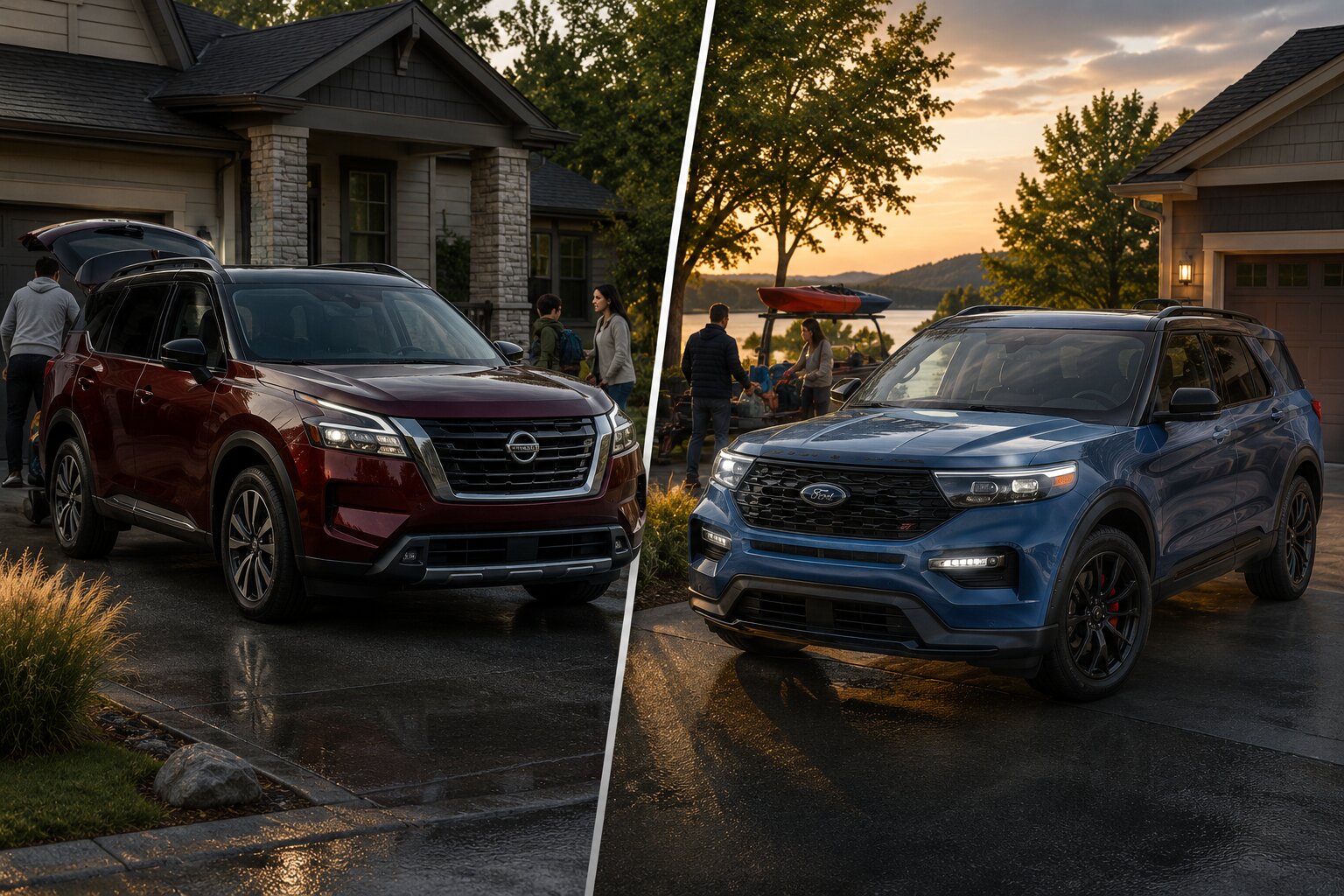
Nissan Pathfinder vs Ford Explorer: two different flavors of “family SUV”
I live in Detroit, which means I see three row SUVs the way other cities see coffee shops. They are everywhere, they all claim to do everything, and the differences matter most when you are tired, late, and trying to thread a wide vehicle into a tight parking spot with kids in the back asking why you took the “long way.”
The Nissan Pathfinder and Ford Explorer sit right in the center of that reality. Both are mainstream three row crossovers with available all wheel drive, real towing chops (at least on paper), and enough trim walk to fill a dealer lot. But their personalities diverge. The Pathfinder leans into calm utility, with a comfort first attitude and an old school V6 paired to a traditional automatic. The Explorer plays the “everyday muscle” card more convincingly, especially with its turbocharged engines and rear wheel drive based platform that tends to feel a little more athletic in typical driving.
To keep this grounded, I am focusing on current generation models sold new today: the Nissan Pathfinder (redesigned for 2022) and the Ford Explorer (current generation launched for 2020, updated for 2025). Specs vary by trim and drivetrain, so I will call out where numbers change. When exact figures depend on configuration, I will say so.
The basics you can verify quickly
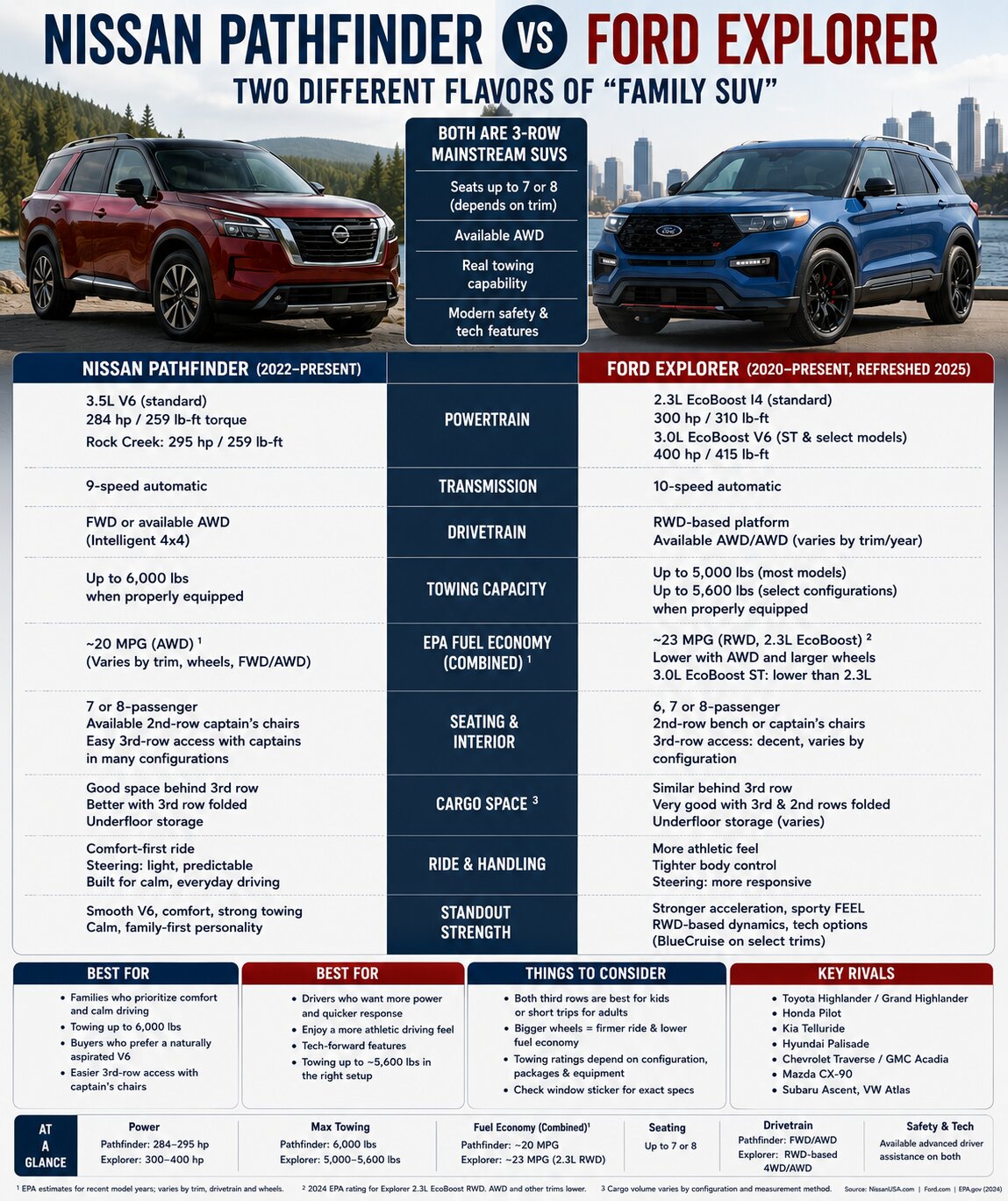
Nissan Pathfinder (2022 to present generation): Standard 3.5 liter V6 with 9 speed automatic. Nissan rates it at 284 horsepower and 259 lb ft of torque in most trims, with the Rock Creek rated at 295 horsepower (torque stays 259 lb ft). Drivetrain is front wheel drive or optional all wheel drive depending on trim. Max towing is 6,000 pounds when properly equipped.
Ford Explorer (2020 to present generation, refreshed for 2025): The mainstream engines have been a 2.3 liter EcoBoost turbo four at 300 horsepower and 310 lb ft, and a 3.0 liter EcoBoost twin turbo V6 at 400 horsepower and 415 lb ft in ST models (and also used in other high output applications depending on year and trim). Explorer is rear wheel drive based with available four wheel drive or all wheel drive depending on trim and year. Towing varies by engine and equipment; broadly, properly equipped Explorers are commonly rated up to 5,000 pounds, with some configurations rated up to 5,600 pounds.
Fuel economy: EPA ratings depend heavily on trim, drivetrain, wheels, and year. As a reference point using widely published EPA ratings for recent model years: Pathfinder typically lands in the neighborhood of around 20 mpg combined (often cited as 20 combined for AWD), while Explorer with the 2.3 EcoBoost is typically in the low 20s combined (commonly around 23 mpg combined for RWD, lower with AWD). The 3.0 EcoBoost ST generally returns lower numbers than the four cylinder. If you are shopping a specific trim, check the window sticker because wheel size and drivetrain can move the needle.
Main competitors: Toyota Highlander and Grand Highlander, Honda Pilot, Kia Telluride, Hyundai Palisade, Chevrolet Traverse (and GMC Acadia), Mazda CX-90, Subaru Ascent, Volkswagen Atlas. In practice, Pathfinder cross shops most directly with Pilot, Highlander, Telluride, Palisade. Explorer also pulls shoppers from Traverse and Atlas, plus buyers who want something that feels a bit more performance oriented without jumping to a luxury badge.
The school week routine: calm controls vs punchy responses
This is where these SUVs either earn their keep or quietly irritate you over time.
The Pathfinder’s vibe is straightforward. A naturally aspirated V6 paired with a conventional 9 speed automatic tends to behave predictably in stop and go traffic. You do not get that turbo “wait… now go” sensation that some drivers notice in small displacement turbo engines when you tip into the throttle from a crawl. In typical suburban driving it feels linear: press pedal, get motion. That matters when you are easing out of a school drop off lane or merging into a short gap without drama.
The Explorer’s base powertrain is stronger than its “base” label suggests. Ford’s 2.3 liter EcoBoost is rated at 300 horsepower and 310 lb ft of torque, which is more torque than the Pathfinder’s V6 makes. Torque comes in earlier with a turbo engine, so around town the Explorer often feels more eager without needing as much revving. It is not sports car quick in this class unless you step up to an ST, but it has that everyday muscle character: it responds like it has something in reserve.
Steering and road behavior: Platform layout matters here. Explorer’s rear wheel drive based architecture usually brings a more balanced feel when you are hustling through a cloverleaf or making a quick lane change. It can feel less nose heavy than many front drive based crossovers. The Pathfinder is tuned more for calm stability than sharp turn in; it is not sloppy, but it does not encourage you to play hero on an on ramp either.
If your daily loop includes potholes and frost heaves, which is basically my entire Michigan calendar from November through April, both can be comfortable depending on wheels and tires. Larger wheels tend to make any three row SUV ride harsher over sharp edges. In general terms based on how these vehicles are positioned: Pathfinder prioritizes ride comfort across trims; Explorer can vary more by trim because ST oriented setups tend to emphasize control over plushness.
A highway trip reveals who sweats less at 75 mph
A long highway run exposes two things quickly: noise management and powertrain effort.
The Pathfinder’s V6 has an old fashioned advantage on long grades. It does not rely on boost pressure for its peak output; it just spins up as needed. Some drivers prefer that steady build when passing or climbing hills with passengers aboard because it feels consistent even if it has to downshift.
The Explorer’s turbo engines shine when you want effortless passing. Even the four cylinder has torque that can make two lane overtakes feel less like planning a chess move. Step into an Explorer ST with its 400 horsepower twin turbo V6 and you are playing in another league entirely for straight line shove. That said, higher output trims usually come with tradeoffs: cost (without getting into financing), potentially higher tire wear if you drive it hard, and typically lower fuel economy than the base engine.
Cruise comfort and driver assistance tech: Both brands offer modern driver assistance suites including adaptive cruise control and lane keeping aids on many trims. Ford’s BlueCruise hands free system has been offered on certain Explorers depending on model year and package; availability changes by trim and year so you need to verify on the specific vehicle you are considering. Nissan’s ProPILOT Assist is widely available across Nissan’s lineup including Pathfinder trims; again availability depends on configuration.
If your priority is relaxed highway miles rather than quick bursts of speed, both can deliver as long as you choose sensible wheel sizes and do not chase sporty packages that prioritize looks over compliance.
Towing a small trailer: what the numbers actually mean
Towing claims sell SUVs in this segment because they promise weekend freedom: small camper, pair of jet skis, utility trailer full of mulch. The catch is that towing confidence is about more than max rating.
Nissan Pathfinder towing: When properly equipped it is rated up to 6,000 pounds. That headline number is legitimately strong for a mainstream three row crossover and puts it near the top of this class among non body on frame vehicles.
Ford Explorer towing: Many configurations are rated up to 5,000 pounds, with some properly equipped versions rated up to 5,600 pounds. Exact rating depends on engine, drivetrain, axle ratio where applicable, cooling equipment packages such as Ford’s tow package offerings (names vary by year), and sometimes seating configuration.
The real world takeaway: For a “small trailer” scenario like a basic utility trailer or lightweight pop up camper, both are likely fine within rating limits if you pay attention to payload (people plus cargo) as well as tongue weight. If you routinely tow near the upper end of these ratings with passengers aboard, that is where equipment details matter: integrated trailer brake controller availability (varies), cooling capacity included with tow packages (varies), hitch class (factory installed vs aftermarket), and how stable the vehicle feels under load at highway speeds.
I also tell friends to remember this: max tow ratings assume proper setup and do not erase physics. A longer wheelbase can help stability; tire choice matters; loading matters; crosswinds matter; so does how often you tow versus how often you just haul backpacks.
Parking lot visibility and “daily annoyance” factors
This class of SUV lives in parking lots. School lots especially have their own rules: tight lanes, unpredictable pedestrians, doors flung open without warning.
Sightlines differ by design philosophy. The Pathfinder has a fairly upright stance that tends to help some drivers place the corners of the vehicle more easily than sleeker shapes do. The Explorer has chunkier proportions too but can feel longer from behind the wheel depending on seat position and rear glass shape; your perception will vary.
Cameras do most of the work now anyway. Both vehicles offer rearview cameras as standard per federal requirement; higher trims add surround view systems depending on options packages. If parking stress is high on your list of daily pain points, prioritize trims with 360 degree cameras rather than bigger wheels or cosmetic upgrades.
Maneuvering feel: Some buyers like steering that feels light at low speeds because it reduces effort in tight spaces; others interpret it as numbness. These two generally lean toward easy steering rather than heavy feedback because they are family SUVs first. If steering feel matters to you personally (it does to me), test drive them back to back through an actual parking lot route instead of only doing dealership loops.
Third row comfort: usable vs “in case of emergency” seating
This is one of those topics where marketing photos lie by omission. Three row SUVs vary wildly in how realistic their third rows are for actual humans beyond elementary school age.
The honest truth about this segment: Most midsize three row crossovers have third rows best suited for kids or shorter adults for shorter trips. Some models like Volkswagen Atlas have built reputations for adult friendly third rows; others prioritize cargo space behind the third row instead.
Nissan Pathfinder packaging highlights: One widely noted practical feature is Nissan’s available second row captain’s chairs setup that can allow easier access to the third row without removing a child seat in certain configurations (Nissan has marketed this feature heavily). Whether it works for your family depends on car seat type and how you install it; bring your actual car seats if possible when shopping.
Ford Explorer packaging highlights: Explorer also offers second row captain’s chairs or bench depending on trim; access can be decent but varies by configuration and how far forward the second row slides. Because Explorer rides on a rear drive based platform shared conceptually with other Ford products from this era (not meaning parts interchangeability so much as layout), its interior packaging sometimes feels different from front drive based rivals when it comes to floor height and seat mounting points.
If third row comfort is mission critical for teens or adults regularly rather than occasionally, I would widen your test list beyond these two to include models known for space efficiency such as Traverse or Atlas. If your third row use case is mostly kids plus occasional short hops for adults around town, both Pathfinder and Explorer can work fine depending on seating position tolerance.
Cargo space: what happens behind the third row?
You can tell how honest an automaker is about family life by how much space remains behind the third row when all seats are up.
I am not going to throw cargo volume numbers around without tying them directly to official sources because they vary by measurement method (SAE vs older standards) and by whether underfloor storage counts in published figures. What I can say confidently about day to day use: both offer usable cargo areas when running five seats down; both get tight behind the third row compared with larger three row crossovers like Traverse or Atlas; both become genuinely useful haulers when you fold rows flat for Home Depot runs or airport duty.
If strollers or sports gear live in your life full time while also carrying seven people occasionally, bring those items when you shop or at least measure them at home first. The difference between “fits” and “fits without swearing” is usually just an inch or two of depth behind that third row seatback angle.
Cabin tech: screens matter less than interface sanity
The tech conversation used to be about screen size alone. Now it is about whether basic tasks require too many taps while driving.
Nissan Pathfinder tech usability: Nissan’s infotainment systems have improved over recent years with clearer menus and better smartphone integration depending on model year and trim (Apple CarPlay support is common; wireless availability depends on trim). Nissan also offers digital gauge clusters on higher trims depending on year and package content. In typical use Nissan tends to keep physical buttons around for key functions longer than some rivals do which many drivers appreciate even if it looks less futuristic in photos.
Ford Explorer tech usability: Ford’s SYNC system has generally been competitive for years in responsiveness and phone integration when properly updated; interface details changed during mid cycle updates including larger portrait style screens appearing across more trims after refreshes depending on model year (not every pre refresh Explorer has that layout). Again this varies by year; if you are comparing new inventory from different build dates you might see meaningful differences inside two Explorers parked side by side.
The practical advice: Sit in each vehicle parked before you drive it. Pair your phone if possible. Adjust climate controls while wearing sunglasses because glare reveals bad screen angles fast. Try changing radio stations without looking down too long because that tells you whether button placement was designed by humans who commute.
Comfort: seats first, then suspension tuning
I have learned over fifteen years of writing about cars that “comfort” means three things: seat shape over time, ride quality over rough pavement at low speed (where suspension tuning gets exposed), and noise levels during highway cruising (where tires become loud roommates).
Nissan Pathfinder comfort personality: The Pathfinder generally aims at softness without feeling floaty. That fits its mission as family transport where most miles are not driven aggressively. The V6 power delivery also contributes because there is no sudden torque surge mid corner when boost hits; it just flows.
Ford Explorer comfort personality: The Explorer can be comfortable too but its range is wider because its lineup stretches from mainstream commuter trims all the way up through ST performance oriented models where buyers expect tighter body control. For many shoppers this means one thing: do not assume every Explorer drives like every other Explorer until you try one configured like yours would be configured.
A note about AWD systems and winter confidence
A lot of buyers around here default to all wheel drive because winter exists whether we like it or not.
Nissan offers Intelligent 4x4 systems on AWD Pathfinders, often paired with selectable drive modes depending on trim level such as snow mode which adjusts throttle mapping and traction control behavior (exact mode names vary). It is designed primarily for traction rather than rock crawling even though some trims add rugged styling cues.
Ford offers four wheel drive or AWD systems depending on year and trim terminology. Because platform layout differs from Nissan’s front drive based setup, power distribution characteristics can feel different under acceleration or slippery conditions even if both ultimately aim at safe predictable behavior rather than off road theatrics.
No matter which badge you pick: good winter tires will do more for stopping distance and steering control than AWD alone ever will.
The ownership side: maintenance reality checks without scare tactics
I cannot promise any individual vehicle will be trouble free or problematic because reliability varies by build quality luck, maintenance habits, driving conditions, previous owner behavior if buying used later on, and even software updates now that cars are rolling computers.
I can point out some ownership relevant differences that are factual:
Nissan sticks with a naturally aspirated V6 here instead of a turbo four as standard equipment. Some owners prefer fewer turbo related components over long term ownership simply because there is less complexity underhood compared with modern boosted engines (turbocharger hardware itself plus associated plumbing). That does not automatically make it cheaper to own forever but it can influence buyer comfort level when thinking about keeping a vehicle well past warranty coverage.
Ford’s EcoBoost engines deliver strong torque but add complexity compared with naturally aspirated setups. Turbocharged engines have been mainstream long enough that they are no longer exotic but they still require diligent oil change habits using correct specs if you want them happy long term.
Tires and brakes are an often ignored cost driver in this segment. Bigger wheels look great but typically bring pricier tires; performance oriented trims can chew through rubber faster if driven enthusiastically simply due to grip levels and torque output (Explorer ST buyers should budget accordingly).
Resale value: what tends to happen in this class
I am not going to invent resale percentages because those swing year by year based on supply levels, incentives, interest rates, redesign timing cycles (which we are avoiding), fuel prices, even social media trends around certain models such as Telluride popularity spikes in recent years.
The widely understood market reality today: mainstream three row SUVs from Japanese brands often carry strong resale reputations historically due partly to perceived reliability although actual outcomes vary by model generation; Ford SUVs also hold value well when demand stays high but resale can be more sensitive to fleet sales mix historically across some nameplates. If resale matters deeply then check current third party valuation guides close to purchase time using your exact trim mileage assumptions rather than relying only on brand stereotypes from ten years ago.
The competitor context: why these two might end up your finalists anyway
If someone asked me why they should even consider these two when Pilot Telluride Palisade Highlander exist I would give two answers:
The Pathfinder appeals if you want predictable V6 behavior plus strong towing capacity without stepping into body on frame territory like Tahoe territory prices size or fuel use patterns etcetera.
The Explorer appeals if you want powertrain punch especially around town plus a chassis layout that often feels more confident when driven briskly even if most days are not brisk days at all.
The scenario test: which one fits which life?
1) School week routine
If your week looks like short trips lots of stops curbside drop offs coffee runs grocery pickup then Pathfinder’s calm predictable power delivery may feel less fussy day after day especially for drivers who dislike turbo lag sensations even mild ones. Explorer counters with stronger low end torque feel from its EcoBoost four which makes gaps easier but may feel busier if transmission tuning hunts gears depending on driving mode terrain traffic patterns etcetera which varies by calibration year updates too so test drive matters here more than forum opinions do.
2) Highway trip across states
If your idea of comfort includes effortless passing then an Explorer especially with EcoBoost torque will likely feel like it has more immediate shove at 70 mph without needing big downshifts although both will downshift under load because physics again exists. If your idea of comfort includes quiet steady progress then Pathfinder’s V6 smoothness can be appealing particularly if your passengers hate sudden surges or frequent gear changes they notice everything even if they say they do not they do trust me.
3) Towing a small trailer once or twice a month
If towing headroom matters most then Pathfinder’s available 6,000 pound rating stands out plainly assuming proper equipment installed from factory or dealer per Nissan guidance including hitch wiring etcetera. For many small trailer owners though either SUV will do fine within ratings but I would still lean toward whichever offers tow package content easiest access integrated cooling provisions factory hitch harness compatibility because aftermarket solutions exist but factory integration usually feels cleaner long term. Verify tow rating using VIN specific build sheet if possible because assumptions cause expensive surprises.
4) Parking lot visibility daily stress test
This comes down less to brand more to options. Get blind spot monitoring rear cross traffic alert front parking sensors surround view camera if offered. Those features reduce daily friction. Between these two I would choose based on seating position sightlines mirror size camera quality. Ten minutes backing into spaces tells you more truth than reading any review including mine.
0 comments
Join the discussion around this article.
Please login to comment.