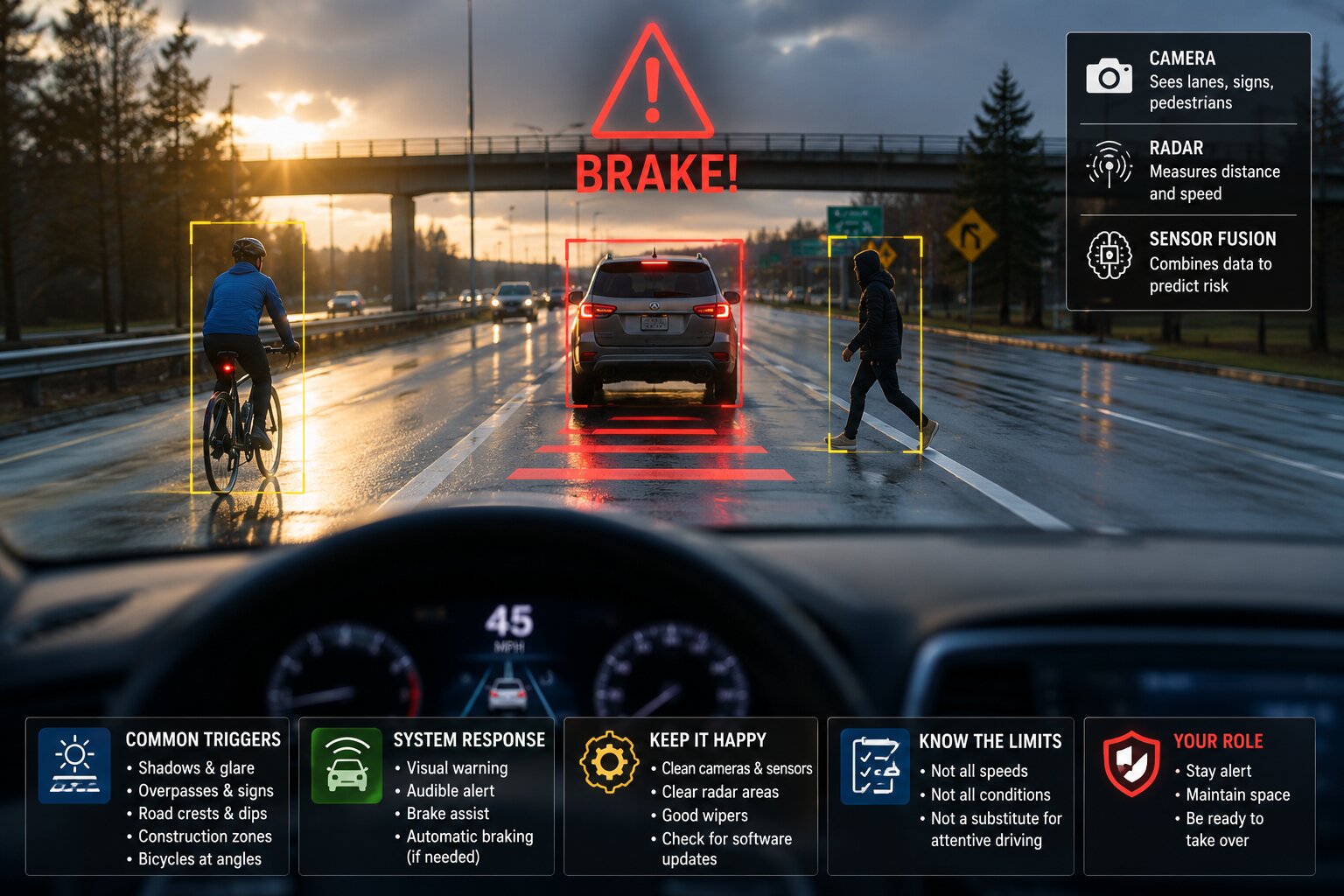
Why AEB can feel “too nervous” in everyday driving
Automatic Emergency Braking (AEB) is designed to reduce the severity of a crash or prevent one altogether by warning the driver and, if needed, applying the brakes. In the U.S., AEB has become common across mainstream brands, and it is often bundled with forward collision warning (FCW). Many systems also include pedestrian detection, and some add cyclist detection and intersection support depending on model year and option package.
That broad adoption is part of why AEB is in the spotlight whenever recalls or software updates make headlines. Owners pay attention because AEB sits right at the boundary between “helpful” and “intrusive.” When it triggers unexpectedly, it can be startling. It can also erode trust in the system, which is a problem because the moments when it truly matters are usually sudden and stressful.
AEB is not a single technology. Some vehicles rely primarily on a forward camera mounted near the rearview mirror. Others combine that camera with millimeter wave radar behind the grille or emblem, and some newer designs add additional sensors. The general rule is simple: sensor fusion (camera plus radar) can improve robustness in certain conditions, but no setup is perfect. Shadows, glare, rain, road crests, bicycles at odd angles, and cross traffic can all push a system toward false alerts or late detection.
Verified basics: what AEB typically uses and what it is meant to do
Widely used AEB systems look for objects in the vehicle’s path and estimate closing speed and time to collision. The camera contributes shape recognition and lane context. Radar contributes distance and relative speed information that can work well in darkness or light rain, though radar has its own limitations with stationary objects or complex scenes depending on tuning.
Most owner’s manuals describe a familiar sequence: visual warnings in the cluster or head up display (if equipped), audible alerts, then brake assist or automatic braking if the driver does not respond. Some vehicles also tighten seatbelts or pre charge brakes as part of a broader pre collision strategy. Exact behavior varies by brand and model year, so it is worth checking your manual for your specific system name and its stated operating conditions.
What you should not assume: that AEB will always stop the car, that it will recognize every bicycle or pedestrian in every lighting condition, or that it will work reliably at any speed. Many systems are designed to reduce impact speed rather than guarantee a full stop. The fine print matters, and manufacturers typically specify speed ranges for certain features. If your manual does not state them clearly, that information may be in a technical supplement or on the manufacturer’s support site.
Common “false alarm” scenarios: shadows, overpasses, and visual clutter
Shadows across the road. Long shadows from trees, utility lines, or an overpass can create sharp contrast bands that briefly resemble an obstacle edge to a camera based system. This tends to show up when the sun is low and you crest a hill into alternating light and dark patches. A well tuned system usually filters this out, but some vehicles will throw an FCW alert or briefly prime braking.
Overpasses and roadside signs on curves. On a bend, an overhead structure or sign support can appear aligned with your path until steering angle data catches up. If you are accelerating into a curve with traffic ahead at varying distances, the scene can look “busy” to both camera algorithms and radar tracking logic.
Road crests and dips. At the top of a hill, the camera’s view of the road surface changes abruptly. The system may momentarily lose lane context or misjudge how quickly you are closing on an object beyond the crest. Drivers sometimes describe this as a “phantom” alert right as they transition over the rise.
Construction zones. Temporary barriers, cones, reflective drums, steel plates, lane shifts, and uneven pavement create exactly the kind of high contrast geometry that can confuse perception systems. Even when AEB does not brake, FCW alerts may become more frequent because following distances compress and lateral offsets change quickly.
Bicycles: why they are hard to interpret even for good systems
Bicycles challenge driver assistance systems because they are narrow objects with moving limbs (rider pedaling), changing profiles (turning handlebars), and frequent lateral motion relative to traffic lanes. Depending on angle and lighting, a bicycle may present very little surface area to radar return compared with a car. Cameras can identify cyclists using pattern recognition, but performance depends heavily on contrast, occlusion (a car partially blocking view), weather on the windshield glass near the camera area, and whether the cyclist is centered in the lane or riding along an edge line.
A particularly tricky scenario is a cyclist crossing at an oblique angle near an intersection while your vehicle is turning slightly or tracking around a curve. The system has to decide whether that cyclist will enter your path or remain outside it. That decision happens quickly, often with imperfect information.
If your vehicle offers settings for FCW sensitivity (often labeled early/medium/late), consider that bicycles in mixed traffic are one reason some drivers choose a less aggressive warning setting for daily commuting. It will not change physics or sensor limits, but it may reduce nuisance alerts without disabling safety functions entirely. Always confirm what each setting actually changes in your specific vehicle because some brands adjust warning timing more than braking thresholds.
Cross traffic: why forward AEB may not “see” what you expect
A common misunderstanding is expecting forward AEB to react like cross traffic alert at low speed intersections or parking lots. Forward AEB generally looks ahead in your lane path. Cross traffic alert is typically handled by different sensors (often rear corner radar modules) designed to detect vehicles approaching from the side when you are backing out of a space. Some newer vehicles also offer intersection assist that can apply brakes when turning left across traffic, but that feature is not universal and may be limited by speed range and sensor coverage.
If you experience abrupt braking when another vehicle passes across your path far ahead while you are approaching an intersection, it may be because the system briefly predicted a collision course based on closing speed before updating its track as the other vehicle cleared your lane line projection.
If you experience no intervention at all when something crosses close in front of you at low speed, that can also be normal depending on design limitations. Many systems prioritize avoiding unnecessary braking events in complex urban scenes where false positives would be frequent. That tradeoff can feel uncomfortable if you expect full coverage in every direction.
Camera based braking has specific weak points
Cameras excel at classification: identifying pedestrians versus cars versus lane markings under good visibility. Their weak points are also intuitive once you think like an engineer staring through glass.
Glare and low sun angles. Direct sunlight can wash out contrast and reduce effective dynamic range. You might see it yourself as a hazy windshield area near the mirror mount right when you need crisp detail.
Fogged glass or interior film. Even if your windshield looks clean from outside, interior haze from off gassing plastics or smoke residue can scatter light right where the camera looks through. That can degrade performance without being obvious until night driving.
Rain droplets and road spray. Wipers clear most of your view but may leave streaks near the camera’s sweep boundary depending on blade wear and windshield shape. Road spray film builds quickly behind trucks in winter slush conditions.
Snow and ice buildup. A thin frost band near the top of the windshield can sit directly in front of the camera housing area while leaving most of your forward view intact from the driver’s seat.
Aftermarket windshield replacement issues. Many vehicles require precise camera calibration after windshield replacement because camera aim matters for distance estimation and lane geometry mapping. Calibration requirements vary by brand; some need static targets in a shop bay plus dynamic road calibration afterward. If AEB behavior changes after glass work, calibration should be high on your checklist.
What those alerts usually mean (and what they do not)
The most helpful mindset is to treat FCW as “the car thinks this could become urgent,” not “the car knows there will be a crash.” Visual alerts often appear first because they are less intrusive than sound or braking. Audible alerts generally indicate higher urgency based on predicted time to collision.
If you feel a brief brake application that releases quickly, many systems are performing either brake pre charge (building hydraulic pressure so full braking happens faster when you press the pedal) or a short intervention meant to prompt driver response rather than stop the car outright. Some vehicles will also pulse brakes lightly as part of warning logic; again this varies by manufacturer tuning.
A key limitation: these systems estimate future motion based on current trajectories. If either you or another road user changes direction quickly after detection begins, predictions shift rapidly. That is where nervous feeling interventions tend to live: borderline cases where probability swings back and forth over fractions of a second.
Safe checks you can do at home: cleaning cameras and sensors correctly
You do not need special tools to reduce many nuisance issues; you do need restraint. Avoid aggressive chemicals or scraping around sensor areas because damage there can be expensive and may require recalibration.
Windshield area around the forward camera:
Use an automotive glass cleaner labeled safe for tinted windows (even if yours are not tinted) plus a clean microfiber towel. Clean inside and outside glass near the mirror mount where many cameras sit behind a plastic shroud. If interior haze is present, two passes help: one damp towel with cleaner followed by a dry towel to remove streaks. Do not pry at camera covers; leave trim alone unless your manual describes owner accessible cleaning steps.
Front radar area:
If your vehicle has radar behind an emblem or panel in the grille area, wash it like painted trim using mild car soap and water. Avoid stickers, paint protection film applied without manufacturer guidance, heavy wax buildup on textured emblems, or license plate brackets that partially block sensor fields on vehicles where sensors sit low in the bumper area. If you have had minor bumper damage repaired, confirm that any radar aiming procedures required by the manufacturer were completed by the shop.
Cameras used for surround view:
If your vehicle uses additional cameras for parking assist or lane functions (depending on model), keep their lenses free of wax residue and road film. Use water and microfiber first; only use cleaner if needed.
Wiper blades matter more than people expect:
A worn blade can leave a thin smear right where forward cameras look through during rain at highway speeds. Replacing blades with quality equivalents is basic maintenance that often improves driver assistance consistency as much as it improves visibility for you.
Settings worth checking before you disable anything
A lot of owners reach for the off switch after one unpleasant event. Sometimes that makes sense temporarily (for example in deep snow where sensors are constantly blocked), but try adjustments first if your vehicle offers them:
FCW alert timing: Many brands let you choose earlier versus later warnings. Earlier warnings reduce reaction time stress but can feel naggy in dense traffic; later warnings feel calmer but give less cushion if someone stops abruptly ahead.
AEB enabled status: Some vehicles separate FCW from AEB so you can keep warnings while disabling braking intervention (or vice versa). Know what you are changing; disabling AEB may affect insurance assumptions or safety expectations for other drivers of your car.
Following distance settings: If your vehicle has adaptive cruise control (ACC), increasing following distance reduces how often FCW logic sees rapid closing events caused by normal traffic compression. It also tends to make highway driving smoother for many people even aside from safety tech concerns.
The recall connection: when software updates are worth asking about
AEB behavior is heavily software driven: object classification thresholds, track persistence logic (how long it keeps believing an object exists), braking timing maps by speed range, and how it blends warnings with intervention all live in code plus calibration data specific to each vehicle platform.
If your vehicle shows repeated false activations in similar conditions after cleaning sensors and confirming no windshield replacement calibration issues, ask your dealer service department to check for technical service bulletins (TSBs) or software updates related to forward collision systems for your exact year and trim level (VIN specific). Manufacturers sometimes refine tuning over time even without issuing recalls; those updates may come as part of broader module reprogramming during routine service visits.
If there is an active recall involving AEB performance for your vehicle model year (or related driver assistance modules), follow manufacturer instructions promptly rather than waiting for symptoms to worsen. Recalls vary widely by brand; this article cannot list them comprehensively without risking outdated information. In the U.S., NHTSA maintains recall lookup tools by VIN that provide verified details directly from filings.
When nervous AEB becomes a real problem
An occasional alert over shadows is annoying but not automatically abnormal; these systems operate probabilistically in messy environments. Certain patterns deserve more urgency:
Repeated unexpected braking with no visible hazard, especially at higher speeds on clear days with clean sensors.
A dashboard warning light indicating sensor blockage or malfunction that persists after cleaning and restarting the vehicle per manual guidance.
A change after repairs, such as windshield replacement, front end collision repair, alignment work involving steering angle sensors, or bumper removal for accessory installation.
Error messages tied to camera calibration, which some vehicles display after battery disconnects or module updates until calibration completes successfully.
If any of these occur, schedule service rather than trying to reproduce it yourself on public roads. Dealers have scan tools that read fault codes from ADAS modules plus manufacturer guided calibration procedures that independent shops may also perform if properly equipped.
A few habits that reduce nuisance alerts without gaming the system
You should not change how you drive just to “beat” AEB; unpredictable driving increases risk for everyone around you. Still, several normal best practices tend to make these systems behave more smoothly:
Maintain steady lane position through shadow bands. Small steering corrections right as contrast changes can temporarily confuse lane path prediction in some situations because both lane geometry estimation and object tracking update together.
Avoid tailgating. This sounds obvious until commuter traffic compresses; short gaps increase closing rate spikes that trigger FCW logic even when everyone is behaving normally within their own bubble of impatience.
Treat construction zones as sensor hostile environments. Slow down earlier than usual when safe to do so; this reduces abrupt closing rates that trip warnings around barriers and temporary lane shifts.
The bottom line: trust it as backup, understand its boundaries
AEB has real safety value when it catches an imminent rear end crash caused by distraction or sudden traffic stoppage ahead; independent testing organizations have documented meaningful crash reductions associated with AEB adoption across fleets over time (results vary by study design). At the same time, nervous behavior around shadows, bicycles at odd angles, reflective construction hardware, and complex cross traffic scenes reflects genuine engineering limits rather than simple “bad design.” Cameras see through glass under imperfect lighting; radar sees shapes differently than humans do; software must choose between acting too often versus acting too late.
The practical approach is unglamorous but effective: keep glass clean inside and out near camera areas; keep front sensor surfaces free of snow crusts and grime; replace worn wipers; confirm calibrations after windshield or bumper work; review sensitivity settings; then ask about software updates using your VIN if nuisance events persist. That sequence respects both safety and sanity without encouraging risky experiments on real roads.
0 comments
Join the discussion around this article.
Please login to comment.