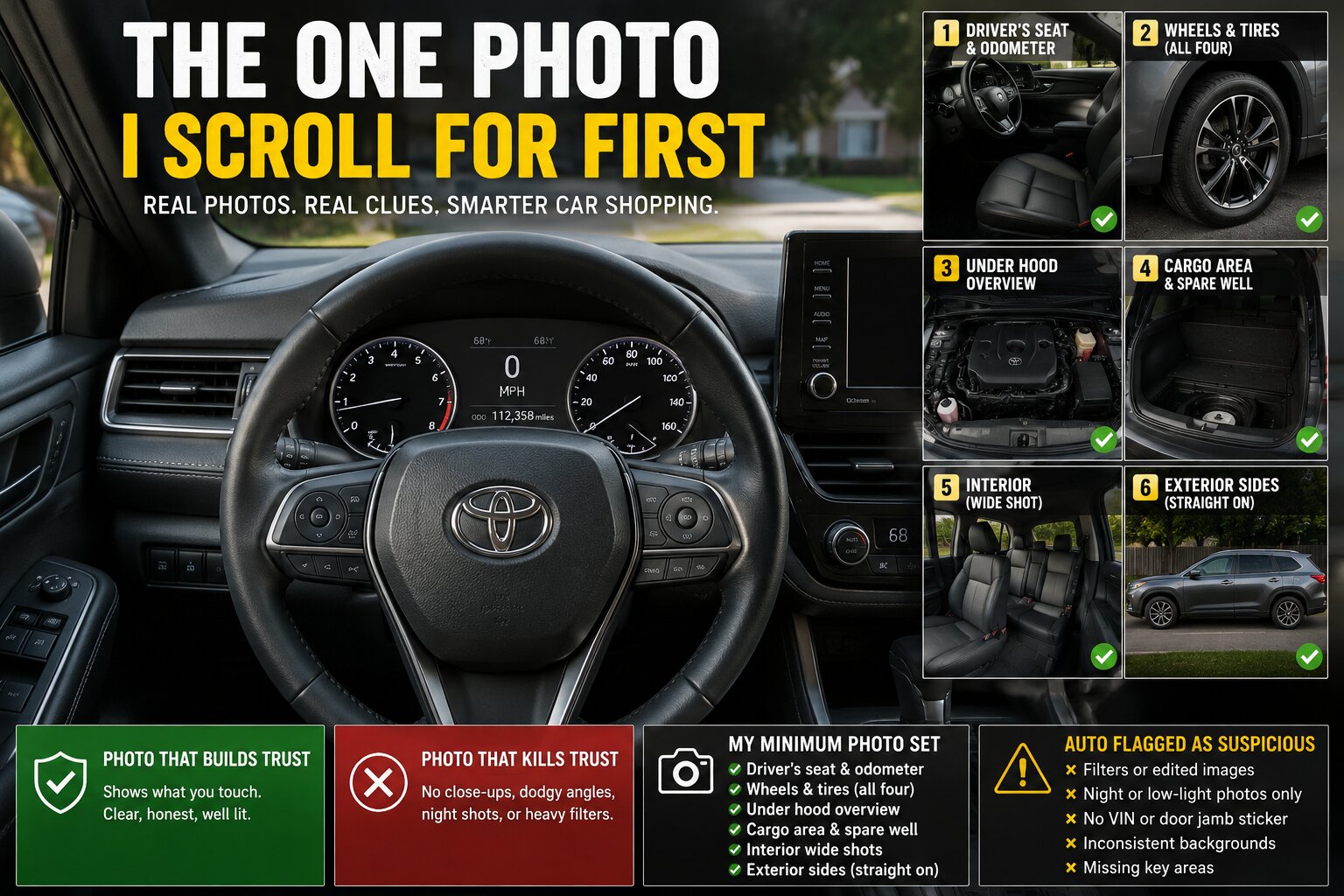
The one photo I scroll for first
When I’m shopping a used car listing, I’m not looking for the glamor shot. I’m looking for the photo that feels like the seller is done hiding. For me, that’s a clear, well lit shot of the driver’s seat and steering wheel, taken straight on, with the odometer visible in the same frame if possible.
It’s not because I’m obsessed with mileage as a status symbol. It’s because those touch points tell the truth about daily life: how the car was treated on commutes, school drop offs, and long highway slogs. Leather that’s cracked or shiny from wear, a steering wheel that’s rubbed smooth at 10 and 2, a sagging seat bolster. Those details are hard to “detail away,” and they line up with the story the listing is trying to tell.
Why that interior shot builds trust
Most sellers can stage an exterior photo. Everybody knows to shoot at golden hour and avoid the curb rash side. Interiors are harder. If a seller posts a crisp cabin photo that shows the stuff buyers actually touch, it usually means they’re not afraid of scrutiny.
It also helps you sanity check other claims without needing invented math. A listing might say “mostly highway miles,” but if the driver’s seat looks like it did ten years of rideshare duty, you pause. Or maybe it’s the opposite: higher mileage, but the cabin looks cared for, with consistent wear and no mystery stains. That doesn’t guarantee anything mechanically, but it changes how I approach the conversation.
The trust killer photo (or missing photo)
The fastest way to lose me is refusing to show problem areas. If there are no close ups of wheels and tires, I assume curb rash or mismatched rubber. If there’s no under hood photo at all, I start thinking about deferred maintenance, missing covers, or leaks that would be obvious in a simple snapshot.
And if every image is shot at night, in rain, or with heavy filters, it reads like someone trying to keep you from seeing paint condition. Same goes for cropped photos that conveniently avoid panel gaps. That matters because uneven gaps can be a sign of prior body work (not always a deal breaker, but it should be disclosed).
A quick reality check on “specs” in listings
Listings love big numbers, but the numbers only help if they’re accurate and specific. A Ford F 150 might be advertised as “tows 13,000,” but tow ratings vary widely by year, engine, axle ratio, drivetrain, and equipment (and sellers often round up). Same story with EV range on something like a Tesla Model 3 or Hyundai Ioniq 5: range depends on battery size and trim, plus real world conditions. If a listing does not show the door jamb sticker (for tire sizes and GVWR info) or at least identify trim clearly, I treat spec claims as marketing until proven otherwise.
Competitors matter here too because cross shopping changes what you care about. If you’re comparing a Toyota RAV4 to a Honda CR V or Mazda CX 5, you might prioritize interior condition and maintenance records over peak horsepower claims. If you’re comparing three row family haulers like a Toyota Highlander and Honda Pilot, photos of third row usability and cargo area become more valuable than a glossy front three quarter shot.
My minimum photo set before I’ll even message
I don’t need thirty photos. I need the right ones:
1) Driver’s seat and steering wheel close up (bonus if odometer is visible).
2) All four wheels and tires close up.
3) Under hood overview in daylight.
4) Cargo area with floor panels lifted if applicable (spare tire well tells stories).
5) Front and rear seats wide shot so I can see wear patterns.
6) A straight on shot of each side of the car (helps spot waviness and mismatched paint).
Your turn: what’s the photo that makes you trust it?
I’m curious what everyone else keys in on because different lifestyles change priorities. A city commuter might care about bumper corners and wheel rash; a road trip family might zoom in on seat fabric and cupholders; truck buyers may want hitch receiver shots and bed floor condition.
Drop your examples using these prompts:
1) Photo that builds trust: What single image makes you think “okay, this seller is real”?
2) Photo that kills trust: What picture (or missing picture) makes you back out immediately?
3) Minimum photo set: What are your non negotiables before you’ll schedule a look?
4) Auto flagged as suspicious: What should platforms automatically flag (filters, night shots only, no VIN photo, inconsistent backgrounds)?
I’ll be in the comments stealing your checklist for my next late night marketplace scroll.
0 comments
Join the discussion around this article.
Please login to comment.