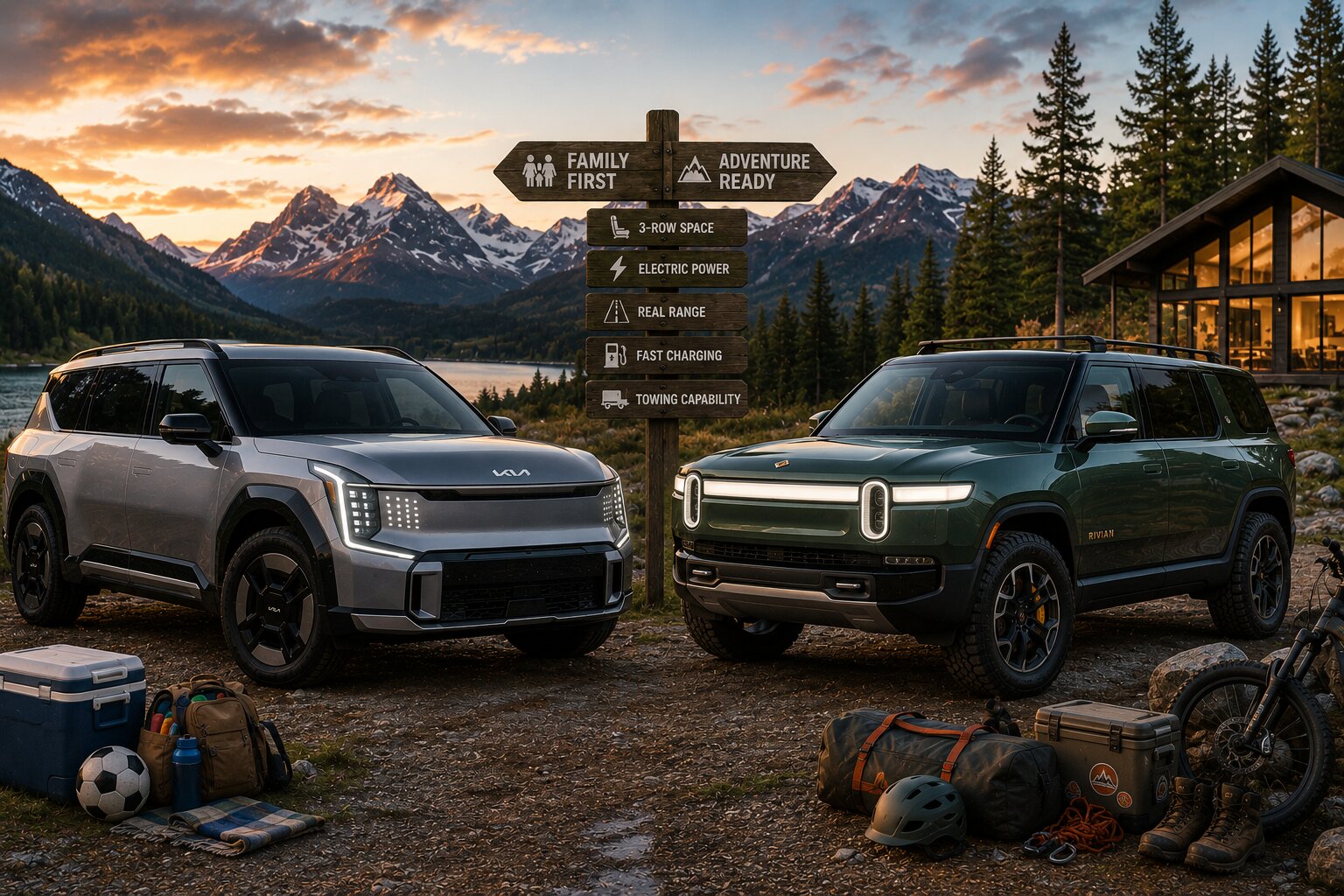
Kia EV9 vs Rivian R1S: the 3-row EV choice comes down to philosophy
On paper, the Kia EV9 and Rivian R1S overlap in a way that would have sounded far-fetched a few years ago. Both are battery-electric SUVs with three rows, adult-friendly proportions, and enough power to make a gas V8 feel like yesterday’s news. In practice, they are chasing different versions of the same American dream.
The EV9 is the mainstream answer: a family-hauler built by a high-volume automaker, sold through a nationwide dealer network, tuned for everyday comfort, and priced to compete with well-optioned three-row crossovers. The R1S is the adventure-first answer: a rugged, tech-forward SUV from a newer brand, engineered with serious off-road hardware and big towing numbers in mind, and sold direct with a different ownership rhythm.
So yes, you can cross-shop them. But the decision often comes down to what you want your electric life to feel like: familiar and family-first, or outdoorsy and slightly more pioneering.
Verified basics: what they are, who they’re for
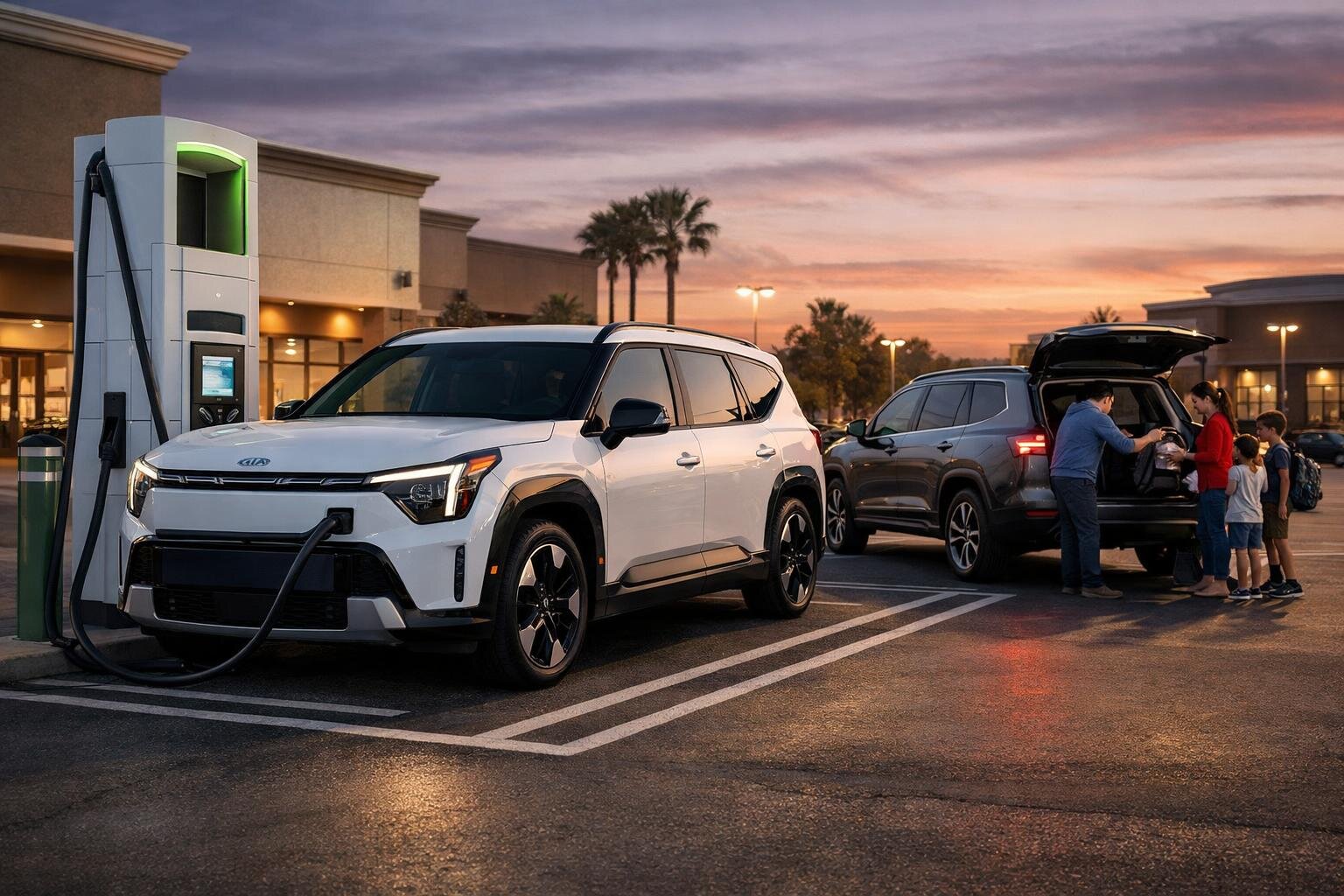
Kia EV9 (U.S.) is Kia’s first three-row electric SUV for America. It rides on Hyundai Motor Group’s E-GMP platform (the same underlying architecture used by vehicles like the Hyundai Ioniq 5/6 and Kia EV6), uses an 800-volt electrical system for fast charging capability, and comes in rear-wheel drive or dual-motor all-wheel drive depending on trim. In the U.S., EV9 trims include Light, Wind, Land, and GT-Line (availability can vary by model year and region).
Rivian R1S (U.S.) is the SUV sibling to the R1T pickup. It is designed around off-road capability and utility, with available air suspension and multiple motor configurations depending on model year and variant. Rivian has offered dual-motor AWD setups and previously offered quad-motor AWD versions; exact availability depends on build date and lineup changes.
Mainstream competitors that shoppers often consider alongside these two include Tesla Model X (pricey but fast and efficient), Volvo EX90 (newer entrant in the three-row premium space), Mercedes-Benz EQS SUV (luxury pricing), BMW iX (two-row but similar money), and more family-priced three-row EVs like the Hyundai Ioniq 9 (newer and not always directly cross-shopped yet). Gas alternatives still pull people back into showrooms too: Toyota Grand Highlander Hybrid, Honda Pilot, Ford Explorer, Jeep Grand Cherokee L.
Power and performance: quick either way, but the delivery is different
Both vehicles can be genuinely quick. The difference is less about whether they have enough power and more about how that power shows up in normal driving.
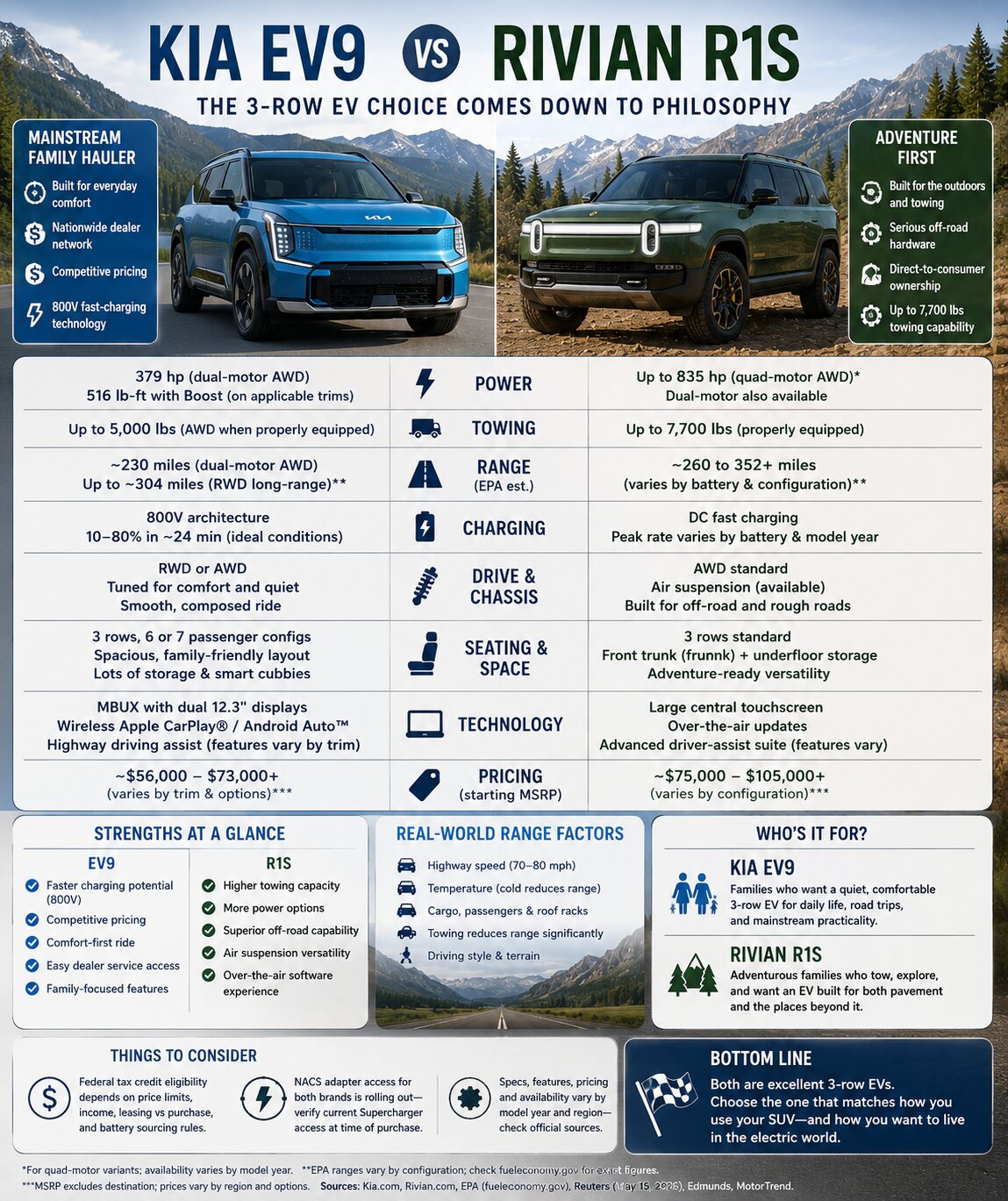
Kia EV9 in dual-motor form is rated at 379 horsepower (Land AWD and GT-Line). Kia also offers a Boost mode on certain trims that increases torque for short bursts; Kia quotes 516 lb-ft with Boost on applicable variants. Rear-wheel-drive versions are less powerful than the dual-motor models. The point is not drag-strip bragging rights; it’s how easy it feels to merge onto a short on-ramp with six people aboard. In typical suburban driving, an EV9 AWD has that smooth, immediate shove you expect from a modern EV without feeling like it wants to turn every green light into a stunt.
Rivian R1S has historically played in a different power league depending on configuration. Earlier quad-motor versions were known for extremely high output; Rivian has quoted up to 835 horsepower for certain quad-motor setups (availability varies by model year). Dual-motor versions are lower but still strong by any normal standard. What matters day-to-day is that the R1S often feels like it has an extra reserve at highway speeds. Passing power is effortless even when loaded, which fits its “do everything” mission.
If your driving life includes lots of short merges, heavy loads, or mountain grades where you want instant passing confidence without planning ahead, both deliver. The Rivian simply tends to do it with more headroom depending on spec.
Towing: both can pull real weight, but one is built around it
Towing is where philosophies get obvious quickly.
The Kia EV9 is rated to tow up to 5,000 pounds when properly equipped (AWD trims). That covers many small travel trailers, lightweight campers, and utility trailers. It also comes with the usual EV caveat: towing will reduce range significantly. Kia includes trailer-related drive modes on some trims to help manage stability and energy use.
The Rivian R1S is rated to tow up to 7,700 pounds. That number lands closer to traditional body-on-frame SUVs than most electric crossovers. More importantly than the rating itself, Rivian’s whole vehicle concept feels towing-aware: robust thermal management design intent, strong low-speed control from electric motors, available adjustable ride height with air suspension on many builds, and a general sense that hauling gear was part of the original brief.
If you tow occasionally and want a family SUV first, EV9’s 5,000-pound rating will be enough for many owners. If towing is frequent or heavy enough that you already know your trailer’s GVWR by heart, the R1S starts making more sense before you even get to range math.
Range expectations: EPA numbers matter here
This comparison lives or dies by range because three-row SUVs are big, and big EVs ask more from their batteries at American highway speeds.
Kia EV9 EPA range varies by trim and drivetrain. For U.S.-market models, EPA-rated ranges are commonly cited around 230 miles for some dual-motor AWD versions, while longer-range rear-wheel-drive variants have higher EPA estimates (exact figures depend on model year and trim). If you are shopping seriously, it is worth checking the specific window sticker or fueleconomy.gov listing for the exact configuration you plan to buy because wheels, tires, and drivetrain move the number meaningfully.
Rivian R1S EPA range also varies widely by motor setup and battery pack size (and Rivian has adjusted its lineup over time). Many buyers will see EPA estimates in roughly the mid-200s to 300-plus miles depending on configuration. Because Rivian offers multiple battery sizes across different years and variants, there is no single number that stays true for every R1S you might find new or used.
The honest takeaway: both can road-trip; neither makes physics disappear. For typical American interstate driving at 70 to 80 mph with passengers and cargo, expect real-world range to be lower than EPA ratings in many conditions (cold weather being the classic spoiler). That’s not a knock on either vehicle; it’s simply how large EVs behave.
Charging speed and road trips: where Kia’s 800-volt system shows its intent
If you do long-distance driving in an EV regularly, charging behavior matters as much as range.
The Kia EV9 uses an 800-volt architecture, which enables very fast DC fast charging when conditions are right (charger capability plus battery temperature plus state of charge). Kia has publicly stated a 10 to 80 percent fast-charge time of about 24 minutes under ideal conditions for EV9. In real road-trip life that translates into shorter stops when you find a high-power charger that can actually deliver what it advertises.
The Rivian R1S uses DC fast charging as well; peak charge rates depend on pack and model year. Rivian does not use an 800-volt architecture in the same way Kia does on E-GMP products. Practically speaking, many owners plan stops based on charger availability rather than chasing theoretical peak rates. Rivian’s advantage is not always raw minutes saved; it’s that its navigation and charging planning ecosystem has matured steadily through software updates.
Tesla Superchargers factor into this story.
Kia has announced plans across Hyundai Motor Group brands to adopt Tesla’s North American Charging Standard (NACS) for future vehicles and provide NACS adapter access for certain existing models; timing varies by brand and model year. Whether an EV9 buyer can reliably use Tesla Superchargers depends on adapter availability plus Tesla opening access to specific non-Tesla vehicles at specific sites. This situation changes quickly; shoppers should verify current compatibility at time of purchase rather than assume universal access.
Rivian has also announced NACS adoption for future vehicles and access plans involving Tesla’s network via adapters (again subject to timing and rollout details). As with Kia, confirm current status rather than buying based on promises alone.
If you road-trip constantly today and want maximum predictability right now in America’s charging landscape, Tesla still sets the benchmark as an ecosystem. Neither Kia nor Rivian fully replicates that experience everywhere yet. Between these two specifically, Kia brings very fast charging potential when infrastructure cooperates; Rivian brings an integrated ownership approach where route planning has become part of the brand’s core competence.
A daily-driver feel check: steering effort, ride comfort, noise
I’m not going to pretend one paragraph can replace a test drive because these two SUVs sit differently in your hands even before you touch a menu screen.
Kia EV9’s vibe is calm-first. It was clearly tuned as a family vehicle meant to spend most of its time doing school runs, commuting, errands, then occasional highway trips. The steering tends toward light effort rather than heavy feedback because most buyers prefer easy maneuvering in parking lots over granular road texture coming through the wheel. Ride comfort is typically described as composed rather than sporty; it aims to isolate passengers from broken pavement without feeling floaty.
The Rivian R1S feels more “tool-like.” Even if you never leave pavement, there’s an underlying sturdiness baked into how it goes down the road that fits its outdoors positioning. Many builds include adjustable air suspension which can change ride height and influence ride quality depending on mode selection. That adjustability is part of the appeal if your life includes snowed-in driveways or rutted access roads. The tradeoff is complexity: air suspension systems add components that do not exist on simpler setups.
Cabin noise is hard to generalize without instrumented testing across trims because tires matter so much here (especially if one vehicle is wearing more aggressive all-terrain rubber). Still, big-boxy SUVs tend to pick up wind noise at speed compared with sleeker shapes; both are tall vehicles designed around space first.
Cabin layout: family-friendly design vs adventure-first packaging
This is where many shoppers stop thinking about horsepower entirely.
Kia EV9 interior packaging leans into daily usability: big openings for child seats, straightforward access to three rows (depending on second-row configuration), lots of storage opportunities up front because there’s no transmission tunnel in the traditional sense. Depending on trim you can get second-row captain’s chairs or bench-style seating arrangements geared toward moving people comfortably rather than maximizing cargo at all times.
Kia also offers features aimed at family comfort such as available heated and ventilated seating depending on trim level (availability varies), plus driver assistance tech that has become expected in this price class such as adaptive cruise control functionality (exact feature names vary by model year).
Rivian R1S interior packaging prioritizes gear-hauling flexibility alongside passenger space. Three rows are standard; overall cargo utility benefits from thoughtful storage solutions including a front trunk (frunk) typical of many EVs but especially useful when your rear area is packed with muddy gear or groceries you do not want sliding around near luggage. The cabin design language feels modern-minimalist with heavy reliance on central screens rather than physical buttons for many functions.
If your daily life involves car seats plus strollers plus Costco runs plus sports bags all at once, both can cope. The difference comes down to how much you value “minivan logic” versus “basecamp logic.” The EV9 generally feels like it was optimized around families living in suburbs who want a quiet place to spend time together while moving efficiently through traffic. The R1S generally feels like it was optimized around families who also have bikes hanging in the garage year-round.
Cargo practicality: third row up vs third row folded reality
This category can get messy because published cargo volume numbers vary depending on measurement method (behind third row vs behind second row vs maximum), and manufacturers do not always present apples-to-apples figures across brands.
The practical truth most owners learn quickly: three-row SUVs are judged by how usable they are with all three rows in play because that’s when space gets tight during airport runs or weekend trips with friends.
The Kia EV9, being long and boxy with a tall roofline for its class, tends to offer genuinely usable third-row seating compared with smaller crossovers pretending to be three-row vehicles. With all rows up there will still be limited cargo depth behind the third row compared with folding it flat; that’s normal for this segment.
The Rivian R1S, also tall and boxy with SUV proportions built around utility needs, adds another layer of practicality via underfloor storage opportunities plus frunk space up front for items you want separated from passengers or wet gear kept away from carpeting inside.
If you frequently travel with seven people plus luggage for everyone, neither vehicle magically becomes an Escalade ESV sized cavern. You may still need a rooftop box or hitch carrier depending on how your crew packs. But both are among the more honest three-row designs in today’s EV market because they were engineered as large vehicles from day one rather than stretched from smaller platforms at the last minute.
Tech experience: screens everywhere vs buttons where you want them
Kia’s approach tends to balance touchscreen features with conventional usability expectations from mainstream buyers. You get modern infotainment with smartphone integration expectations (Apple CarPlay and Android Auto availability depends on model year; verify current spec because automaker strategies have shifted over time). The bigger point is familiarity: if you’ve driven other recent Kias or Hyundais you’ll recognize how menus are structured and how driver assistance features behave.
Rivian’s approach leans heavily into software-defined ownership: big central display controls much of the vehicle; updates arrive over-the-air; features evolve over time more like consumer electronics than traditional automotive model years. That can be satisfying if you enjoy waking up to new capabilities after an update cycle. It can also be mildly frustrating if you prefer stable interfaces that never move your favorite setting into another submenu after a redesign.
Road-trip routines in America: where each one fits naturally
If your idea of travel involves interstate highways punctuated by Buc-ee’s stops or national park gateways crowded with families doing exactly what you’re doing, these two SUVs slot into different rhythms.
The EV9 road-trip personality: It wants predictable comfort above all else. Wide seats matter more than ultimate cornering grip when you’re six hours deep into I-40 traffic outside Nashville. Fast charging potential helps if your routes have reliable high-power stations along them because shorter stops keep kids happier even if nobody says it out loud until later.
The R1S road-trip personality: It tends to feel like it was designed assuming some portion of your trip ends off pavement or at least off grid lines painted by DOT crews. If your itinerary includes dirt roads leading to trailheads or snow-covered approaches where ground clearance becomes real instead of theoretical marketing copy, its adjustable suspension options can feel like money well spent.
Efficiency: no mpg here, but energy use still hits your wallet
You asked for fuel economy; in EV terms we talk about MPGe or kWh per 100 miles rather than mpg since neither vehicle burns gasoline.
Kia EV9 MPGe figures: EPA MPGe varies by trim/drivetrain/wheels; check fueleconomy.gov for exact ratings for the specific version you’re shopping because differences between rear-wheel drive versus AWD are meaningful in efficiency terms.
Rivian R1S MPGe figures: Also varies by configuration; larger tires and more aggressive tread patterns tend to reduce efficiency across any brand because rolling resistance goes up. Again this is best verified per configuration via EPA listings where available.
A grounded ownership note: big three-row EVs can be surprisingly sensitive to speed. If your typical highway pace creeps above posted limits in wide-open states (which happens), expect consumption to rise noticeably regardless of badge.
Pricing reality: mainstream value vs premium-adventure positioning
Kia EV9 pricing: In the U.S., EV9 starts far below most premium three-row electric SUVs but can climb quickly as you move into upper trims like GT-Line with AWD equipment levels. Exact MSRP changes by model year; verify current pricing at kia.com or window stickers for dealer inventory because destination charges and option packages shift totals meaningfully.
Rivian R1S pricing: Typically sits higher than an equivalently sized mainstream SUV because it positions itself as premium-adventure tech hardware. Prices have changed over time due to lineup updates; confirm current MSRP directly through Rivian since sales are direct-to-consumer rather than traditional dealer negotiation structure in most cases.
An important incentive note: eligibility for U.S. federal tax credits depends on price caps, assembly location rules, battery sourcing rules, buyer income limits, leasing structures that sometimes pass through credits differently than purchases, plus ongoing policy changes. Both brands’ eligibility can vary by trim/model year/transaction type; verify current IRS guidance and dealer or manufacturer lease terms rather than assuming any credit applies automatically.
Maintenance expectations: fewer fluids than gas SUVs but not “no maintenance”
No oil changes sounds great until reality sets in that tires are still tires and brakes are still brakes even if regenerative braking reduces wear in many cases.
Kia EV9 maintenance factors: As a high-volume automaker product sold through dealers nationwide, routine service logistics may feel straightforward for many buyers simply because locations are plentiful in most metro areas. Typical maintenance items remain tire rotations/balancing/alignment checks due to weight-related tire wear risk common among large EVs; cabin air filters; brake fluid service intervals per manufacturer schedule; coolant service related to battery thermal management per schedule (interval specifics should be checked in official documentation).
Rivian R1S maintenance factors: Rivian operates service centers plus mobile service capabilities depending on region; coverage has expanded but still varies widely across states compared with legacy dealer networks. That can be totally fine if there’s a service center within reasonable distance; it becomes a bigger consideration if you live far from one or routinely travel rural areas where support logistics matter more than they do for city dwellers.
Resale value: what we know vs what we should not pretend we know
This topic invites confident claims that rarely hold up across changing market cycles.
The verified reality is that resale values depend heavily on broader EV demand swings (interest rates matter), new-vehicle price cuts across brands (Tesla pricing moves affect used values across segments), battery size desirability over time as charging improves, software support longevity perceptions, warranty transferability rules by brand/model year where applicable, plus local market conditions.
Kia resale outlook: Kia has improved brand perception substantially over recent years but resale outcomes vary widely by model line and market conditions; there isn’t enough stable long-term data yet specific to used EV9 values across multiple years because it is still relatively new as a nameplate in this segment.
Rivian resale outlook: Rivian demand has been strong among certain buyers but used values have also been influenced by pricing changes over time plus broader used-EV volatility industry-wide. Again there is not decades-long historical stability here like there might be for something like a Toyota 4Runner because this segment itself is young electrically speaking.
Safety and driver assistance: check trims carefully
SUV shoppers often assume every expensive new vehicle aces every crash test immediately; that isn’t always how public ratings roll out since agencies test over time using specific configurations available at test date.
You should verify current safety ratings from trusted sources like NHTSA and IIHS for each exact model year because results can change as tests update or new variants are introduced. Driver assistance feature availability also varies by trim level on both vehicles; don’t assume top-level features trickle down automatically without checking build sheets carefully.
The ownership vibe: dealer network familiarity vs direct-sales ecosystem
This may be the single biggest non-spec differentiator in day-to-day life after charging access:
Kia ownership rhythm: You buy from a dealer lot or order through dealer channels depending on availability. That means potential negotiation variability (sometimes good for buyers when inventory rises), plus easier access to test drives locally in many regions simply due to dealer footprint size nationwide. Service appointments likely look like traditional dealership scheduling which some people appreciate purely because it feels familiar even if dealership experiences vary widely store-to-store.
Rivian ownership rhythm: You typically order direct online with transparent pricing structure relative to old-school negotiation norms (though taxes/fees remain local realities). Service infrastructure continues expanding but remains less ubiquitous than legacy brands’. Software updates arrive regularly which can make ownership feel dynamic rather than static between model years; some drivers love this sense of progress while others prefer fewer interface changes once they’ve learned their car inside out.
A few decision shortcuts that actually match real life
If you’re stuck between these two after reading spec sheets until midnight, these questions usually clarify things faster than another horsepower comparison:
If your week looks like school drop-offs + commuting + errands + occasional road trips: The Kia EV9 tends to fit naturally because its mission reads as family comfort first with strong charging capability baked into its platform design philosophy.
If your week looks like all of that plus regular outdoor hauling + rough roads + heavier towing:
0 comments
Join the discussion around this article.
Please login to comment.