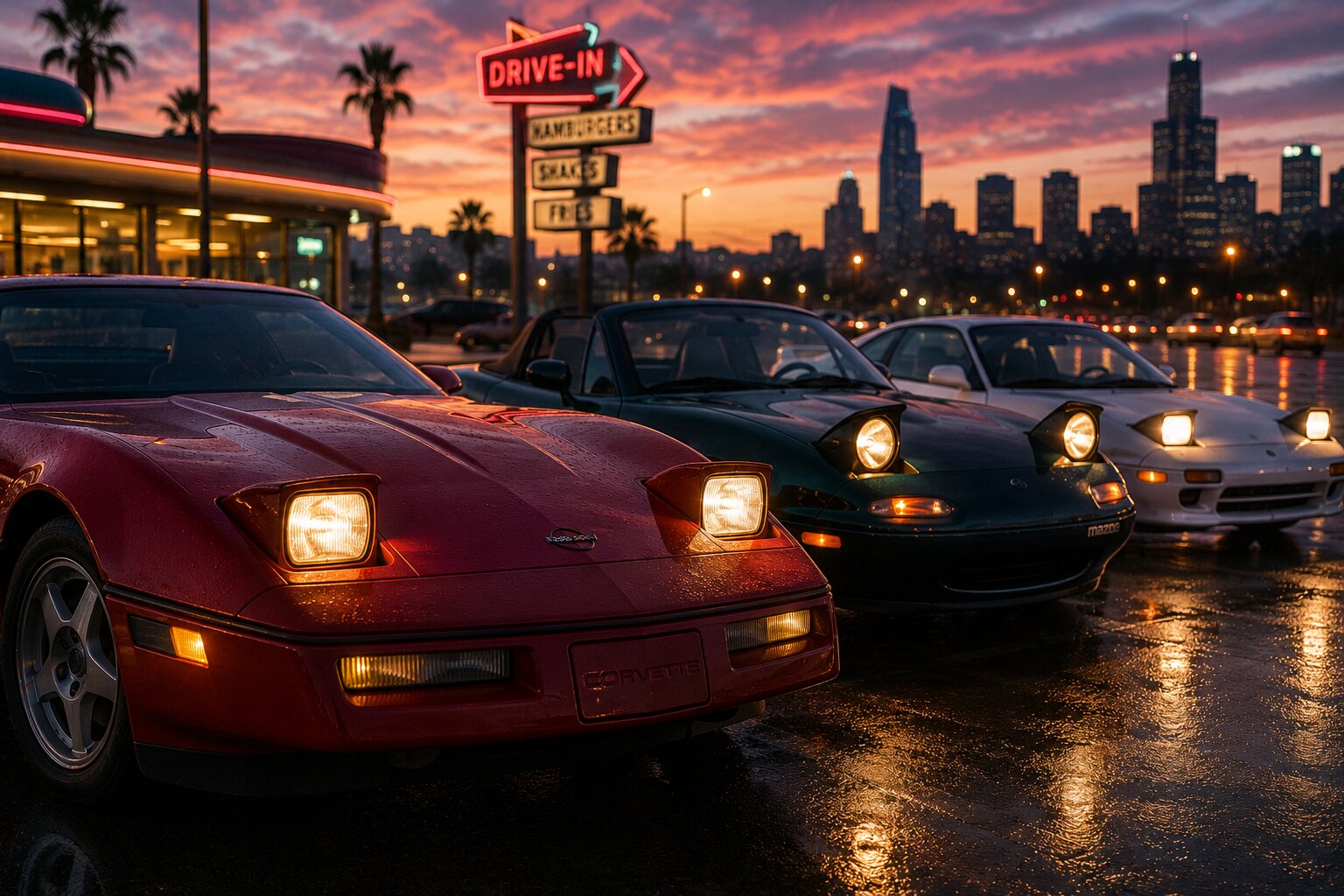
A button, a whir, and a little theater
There is a specific kind of car memory that sticks with you even if you never owned the thing. You are riding shotgun at night, maybe headed to a late movie or cutting across town after a high school game. The dashboard lights glow green or amber. Someone reaches for a switch. A motor whirs. A pair of “eyes” rise out of the hood like the car just woke up.
Pop up headlights were never just lighting equipment. They were a small mechanical performance that made ordinary errands feel like you were piloting something engineered with intent. In the U.S., they became shorthand for sporty cars and modern shapes, from Corvettes and Camaros to imports that looked like they came from a different design planet.
They also vanished almost completely, and not because people stopped liking them. The reasons are a mix of aerodynamics, packaging, safety rules, reliability headaches, and the way modern lighting technology changed what designers could do.
Why pop ups happened: aero, packaging, and the age of the wedge
The basic idea is simple. Sealed beam headlights used for decades in the U.S. had standardized sizes and output requirements that limited styling freedom. For years, if you wanted headlights that met federal requirements, you were often working around fixed round or rectangular sealed beam units (and later replaceable bulb housings). That pushed designers toward upright headlamp faces and taller front ends.
By the late 1960s and into the 1970s, the industry was chasing lower hoods and cleaner airflow. Lowering the nose helps reduce frontal area and can reduce drag, which matters for both performance and fuel economy. It also just looked fast in an era when “aero” became a design language all its own: long hoods, sharp edges, and windshields laid back like speedboats.
Pop up headlights were a clever cheat. You could keep the front end low and smooth most of the time, then raise the lights only when you needed them. That gave designers freedom to draw sleek shapes without permanently dedicating vertical space to headlamp units.
Packaging mattered too. Sports cars often want low hood lines for visibility and style, but they also need room underneath for radiators, intake plumbing, crash structures as those evolved over time, and sometimes big engines. A retractable headlamp mechanism let designers tuck lighting away while keeping the hood line where they wanted it.
The early icons Americans actually saw on the road
Pop up headlights existed earlier in limited form on European exotics, but in American life they became familiar through cars you might realistically spot at a stoplight or on a weekend road trip.
Chevrolet Corvette is one of the clearest through lines. The 1963 Corvette Sting Ray introduced hidden headlights behind rotating panels rather than pop up pods, but it was part of the same pursuit: keep the nose clean until light was needed. Later generations leaned hard into retractables. The C5 Corvette (1997 to 2004) is often remembered as one of the last mainstream U.S. performance cars to use true pop up headlights before the idea went extinct.
Mazda MX 5 Miata deserves its own place in the story because it proved pop ups could live on an affordable, friendly car instead of only on posters. The first generation Miata (NA, sold in the U.S. for model years 1990 through 1997) used pop up headlights as part of its simple sports car charm. It was not pretending to be a supercar; it was a light roadster with modest power by modern standards and an owner base that actually drove them daily.
Pontiac Firebird also carried the torch for years in American driveways and mall parking lots. The third generation Firebird (1982 to 1992) wore pop up headlights that matched its low hood and sharp nose. It fit perfectly into that era’s idea of high tech styling: digital dashboards in some trims, dramatic bodywork packages depending on year and model, and an overall vibe that made even routine commuting feel like science fiction.
Toyota MR2 is another U.S. market staple worth calling out. Both the first generation (AW11, mid 1980s) and second generation (SW20, early 1990s) used pop up headlights in U.S. form. Mid engine packaging already forces creative front end design because there is no big engine under the hood; instead you have luggage space and cooling hardware to manage. Retractables helped keep those cars low and tidy while maintaining headlamp height requirements.
Acura NSX, sold in the U.S. starting in 1991 for early models, brought pop ups into a new kind of credibility: supercar looks with Japanese build quality reputation. It is hard to overstate how much that car influenced what people thought a modern sports car could be in everyday use, even if most buyers never got close to owning one.
Even outside pure sports cars, pop ups showed up where designers wanted drama or an aero look: Lotus Esprit (in federalized form), Porsche 928 (with its distinctive “pop up” style lamps that rotated), and various niche imports that made their way onto U.S. roads through official channels or gray market routes depending on era.
The rulebook in the background: what lighting regulations encouraged
If you talk to designers from that period, regulations come up quickly because lighting is one of those areas where style meets strict requirements. For many years in the U.S., headlamp standards effectively pushed manufacturers toward certain shapes and sizes (notably sealed beam units). Over time those rules evolved to allow more headlamp designs using replaceable bulbs and different lens shapes.
That shift matters because it removed one of the original motivations for hiding headlights: if you can sculpt slim fixed lamps that still meet requirements, you no longer need a mechanical workaround just to get a sleek nose.
There is another regulatory pressure too: safety expectations around what happens when pedestrians are struck by vehicles, along with broader crash requirements that influence front end structure. Pop up mechanisms add hard components near the front corners of a car and create protrusions when deployed. Even if specific rules vary by market and year, the direction of travel has been consistent: fewer sharp edges and fewer external protrusions.
It is also worth being honest about what is difficult to pin down precisely without diving into manufacturer internal documents: there is not one single global regulation that “banned” pop ups overnight across all markets in one stroke. Instead it was an accumulation of pressures including pedestrian impact standards in key markets, plus cost, complexity, warranty risk, weight targets, and changing buyer expectations for reliability and refinement.
The downside owners knew: motors fail, doors stick, alignment drifts
If you grew up around older cars with retractables, you probably remember at least one example with “lazy eye.” One headlight would pop up crisply; the other would hesitate halfway like it needed encouragement. Sometimes it was a tired motor or worn gears; sometimes it was corrosion or binding linkages; sometimes it was electrical gremlins from age.
This is where romance meets real life ownership tradeoffs. Pop up systems require motors or vacuum actuators depending on design, plus linkages, bushings, limit switches or position sensors depending on era, wiring harnesses routed through moving structures, weather sealing around openings in bodywork, and careful alignment so beams aim correctly when deployed.
All of that has to survive years of rainstorms, road salt in northern states, heat cycling under summer sun, minor front end bumps from parking lots, plus owners who might not drive at night often enough to cycle mechanisms regularly.
In typical daily use this meant two things for many owners as cars aged: more maintenance points than fixed lamps have, and more opportunities for annoying quirks rather than catastrophic failures. You could still drive home with one lamp stuck up or down most of the time; it just looked scruffy on a car whose whole point was looking sharp.
Why they disappeared: safety priorities met lighting tech
The end of pop ups was not just about rules or reliability; technology caught up with style goals.
As headlamp designs advanced from sealed beams toward more complex composite housings with better optics (and later projector style units), designers could make fixed lamps thinner while still meeting output requirements. Then came HID systems on some higher end vehicles in the 1990s and widespread LED lighting later on. LEDs especially allow very slim lamp shapes because they can be packaged tightly with efficient optics and thermal management designed into compact assemblies.
Once you can draw a low nose with fixed lamps that look modern day or night thanks to signature lighting elements, there is less reason to accept moving parts at the very front of the car.
Add pedestrian safety expectations into that mix and retractables become harder to justify. A raised headlight door creates an edge where you do not want one during an impact scenario. Even when closed there are gaps around panels that can complicate how front ends deform in carefully controlled ways during crashes.
Then there is efficiency pressure. Pop ups were originally justified partly by aerodynamics when closed; ironically they can be worse when open because they disturb airflow dramatically at highway speeds if you are driving at night or in rain with lights required. As automakers chased every fraction of drag reduction for fuel economy ratings and wind noise reduction for refinement goals, fixed flush lamps became easier to optimize across all conditions rather than only when retracted.
The late era holdouts Americans loved anyway
The final years had a bittersweet feel because some beloved cars kept pop ups right until they could not anymore.
The Mazda MX 5 Miata switched away after 1997; the second generation Miata (NB) arrived for 1999 with fixed headlights under clear covers instead of flip ups. Owners argued about it then and some still do now because those original “sleepy” eyes were part of the NA’s personality.
The C5 Corvette kept them through 2004 before Chevrolet moved to fixed exposed lamps on the C6 for 2005 model year production in most markets (the C6 launched for 2005). That change marked more than styling; it signaled how far lighting design had come since sealed beam days.
The Pontiac Firebird ended after 2002 model year production along with Camaro at that time; by then pop ups were already feeling like an artifact from another era even if they still looked cool rolling out of a fast food drive through at midnight.
You can find other late examples worldwide into the early 2000s such as certain Lotus Esprit variants before production ended in 2004 (U.S.-market availability varied by year). But by then mainstream manufacturers had moved on decisively.
Cultural context: why Americans fell for them
If you want to understand why people miss pop ups now, think about what American driving felt like when they were common: long freeway ramps where you could merge hard even in modest cars; neon lit downtowns; cassette decks giving way to CD players; analog gauges sharing space with early digital displays; radar detectors tucked into ashtrays; road trips where “night driving” felt like part of the adventure instead of something your adaptive LEDs handled automatically.
Pop up headlights fit right into that mood because they made cars feel interactive. You did not just turn on lights; you activated hardware. It was tactile proof your car had moving pieces dedicated solely to looking right while standing still at a stoplight.
The effect also played well across price points in America’s market reality. A Corvette owner got supercar drama without exotic car maintenance budgets (at least relative to hand built imports). A Miata owner got sports car theater while still being able to afford tires and insurance payments more easily than many higher performance options. A Firebird driver got bold styling even if their commute was mostly traffic jams punctuated by short bursts onto open highway.
If you shop one now: charm costs something
Pop up headlight cars are now old enough that buying one is less about finding “a used car” and more about choosing a hobby level vehicle depending on model condition and parts support.
The headlight system itself is not always expensive to fix compared with major drivetrain work, but it can become fiddly: brittle plastic gears on some designs as they age; tired motors; worn bushings; moisture intrusion into connectors; misalignment after minor bumps; previous owner wiring shortcuts when someone got tired of chasing intermittent problems.
If you are browsing listings for an NA Miata or an older MR2 or Firebird today, it is smart to cycle the lights repeatedly during inspection (engine running) and check that both sides rise smoothly at similar speed and sit evenly when closed so panel gaps look uniform. It is also wise to check whether replacement parts are readily available for that specific model year because support varies widely by brand and community aftermarket backing.
The trend that did its job too well
Pop up headlights solved real problems at exactly the right moment: they let designers draw low noses despite restrictive lighting standards while chasing aerodynamic shapes buyers associated with speed and modernity. They added personality without needing horsepower numbers on paper to justify themselves at every stoplight conversation.
Then lighting technology improved so much that hiding lamps stopped being necessary. Safety expectations rose steadily around front end geometry and pedestrian impacts across major markets. Manufacturers had less patience for extra motors at warranty time as buyers demanded quieter cabins and fewer quirks from daily drivers.
The result is a strange kind of victory: pop ups disappeared because their original mission became irrelevant. Still, when you see an older Corvette or Miata blink awake at dusk today, it hits like a time capsule from when aerodynamics looked like wedges and cool factor sometimes won arguments inside engineering meetings.

0 comments
Join the discussion around this article.
Please login to comment.